
Postnatal care at home is professional caregiving support — physical, nutritional, emotional, and newborn-focused — delivered in the mother’s own home during the six weeks after delivery. The World Health Organization recommends at least four postnatal contacts within the first six weeks for every mother and newborn. In Mangalore’s growing number of nuclear family households, where joint-family support is often unavailable, professional Post Natal Care Services in Mangalore provide that structured support in the place where recovery actually happens.
This period — now widely called the fourth trimester — carries its own clinical weight. Nearly half of all post-delivery maternal deaths occur within the first 24 hours after birth, and 75% of newborn deaths happen in the first week of life (WHO). The weeks after discharge are not a winding-down phase. They are a continuation of the high-risk window, now managed at home rather than in a ward.
Understanding Postnatal Care and Its Importance
Postnatal care — also written as postpartum care — refers to health and support services provided to a mother and her newborn from birth through the first six weeks. The WHO’s minimum standard includes monitoring the mother’s physical healing, the newborn’s weight and feeding, and screening for emotional health — all within a structured schedule of contacts starting within 24 hours of delivery.
For the mother, the postpartum period involves simultaneous demands: perineal or surgical wound healing, hormonal change, breastfeeding establishment, and psychological adjustment to a new identity. Research published in ScienceDirect (2021, 20,043 Indian mothers) estimates that approximately 22% of Indian mothers experience postpartum depression — a figure corroborated by Dr. Rooma Sinha, Senior Obstetrician at Apollo Hospitals, who notes that ‘nearly one in five mothers in India’ is affected. Structured postnatal support at home is one of the documented protective factors against this outcome.
Normal Delivery vs C-Section — What Recovery Actually Involves
Normal delivery recovery involves perineal healing, physical fatigue from labour, and reduced mobility in the first week. Most women can move independently within 24–48 hours but remain physically depleted for two to four weeks.
C-section recovery is categorically different — it is major abdominal surgery. The mother faces a surgical wound requiring monitoring, complete restriction on lifting the newborn for the first two to three weeks, dependence on others for basic movement, and a full recovery period that typically runs six to eight weeks. Breastfeeding positions must be adapted to avoid incision pressure. Pain management needs are higher, and the risk of complications — infection, internal bleeding, deep-vein thrombosis — requires continuous observation.
Common Post-Delivery Challenges Indian Mothers Face
- Fatigue and sleep deprivation: Newborns feed every two to three hours through the night. The accumulated sleep deficit in the first weeks is clinically significant — it delays physical healing and is a direct risk factor for postpartum depression.
- Body pain: Back, pelvic, perineal, or surgical wound pain is common and limits daily function in the early recovery weeks.
- Hormonal fluctuation: Oestrogen and progesterone drop sharply after delivery, causing mood swings, tearfulness, and emotional sensitivity in most mothers — normal but often unsupported.
- Breastfeeding difficulties: Latch problems, engorgement, nipple soreness, and uncertainty about milk supply are among the leading reasons Indian mothers discontinue breastfeeding in the first weeks.
- Emotional adjustment: The psychological transition to parenthood — particularly for first-time mothers and those without immediate family support — carries genuine emotional weight that professional care presence can moderate.
Benefits of Postnatal Care at Home for Mothers
Physical Recovery Support
A professional caregiver supports postnatal care for mothers through both normal delivery and C-section recovery. Practical assistance includes mobility support in the first days, wound-area hygiene for surgical recoveries, help with movement and positioning during breastfeeding, and medication reminders for prescribed iron, calcium, and postnatal supplements. The caregiver also observes for early signs of complications — elevated temperature, unusual wound changes, or reduced newborn feeding — that need medical attention.
Emotional and Mental Well-Being
With 22% of Indian mothers experiencing postpartum depression (ScienceDirect, 2021), emotional support is not a secondary feature of postnatal care — it is a clinical requirement. A trained caregiver’s consistent daily presence provides reassurance, companionship, and early observation of mood and behavioural changes. For a mother in a nuclear household with limited family support, a professional caregiver is often the only adult consistently present during the most vulnerable weeks of recovery.
Recovering in familiar surroundings — in the mother’s own home, with family accessible rather than restricted — is itself a documented factor in emotional recovery. The caregiver provides the professional structure; the home provides the emotional baseline.
Proper Nutrition and Hydration
Breastfeeding significantly increases a mother’s daily caloric and fluid requirements. Home help for new mothers from an experienced caregiver includes preparation of nutritionally appropriate meals — including traditional Tulu Nadu postnatal foods such as methi (fenugreek) ladoo, ajwain water, turmeric milk, and protein-rich preparations familiar to coastal Karnataka families — timed to the mother’s feeding and rest schedule.
Hydration is frequently neglected during the intensity of newborn care. Inadequate fluid intake is a preventable cause of reduced milk supply in the first weeks — one that a caregiver manages by ensuring the mother drinks consistently throughout the day.
Better Sleep and Rest
Postpartum home care services that include a dedicated caregiver make genuine rest possible. The caregiver takes on defined newborn care responsibilities during early morning feeds and rest periods, allowing the mother sustained sleep intervals. Without this structure, the mother carries the full burden of night feeding and daytime recovery together — a pattern that both delays physical healing and increases postpartum depression risk.
Newborn Care During the First Six Weeks
Newborns cannot communicate discomfort, hunger, or illness. They depend entirely on caregivers to observe, interpret, and respond to their needs. Postnatal home care services covering the newborn include:
- Bathing: Sponge baths in the first week while the umbilical cord is present, transitioning to full baths with correct water temperature, support technique, and safe product use.
- Diaper care: Correct changing technique and hygiene to prevent nappy rash and infection — particularly relevant in Mangalore’s humid coastal climate.
- Breastfeeding support: Correct positioning for latch, identifying signs of adequate feeding (wet nappies, weight gain), and managing the mother’s comfort during feeds.
- Burping: Technique and frequency matched to the baby’s feeding pattern and any observed reflux.
- Safe sleep positioning: Placing the newborn on their back for sleep — the standard safe sleep recommendation — and early establishment of a predictable sleep-wake rhythm.
- Health monitoring: Observing for jaundice (yellowing of skin or eyes within the first week), umbilical stump healing, weight gain at expected milestones, and feeding frequency changes that need medical review.
First-time parents typically have no reference for what is normal in a newborn’s first weeks. A caregiver’s experience across multiple newborns converts daily uncertainty into confident, informed action.
Why Home Care Works Better Than Repeated Hospital Visits
After hospital discharge, the standard follow-up model is scheduled clinic visits. Between those appointments, postpartum care services at home provide the continuous monitoring that appointments cannot. For Mangalore families seeking postpartum services near me, home-based care also removes the practical challenge of transporting a recovering mother and a newborn to a clinic setting — particularly in the first two weeks when C-section recovery restricts movement significantly.
Home-Based Postnatal Care vs Repeated Hospital Visits — Comparison
| Parameter | Repeated Hospital Visits | Postnatal Care at Home |
| Travel with newborn | Requires transport to clinic — exhausting during recovery weeks | Caregiver arrives at home — zero transport required |
| Infection exposure | Hospital environments carry higher pathogen load for newborns | Familiar home setting significantly reduces exposure risk |
| Care continuity | Appointments only — gaps between visits are unsupported | Daily presence and 24/7 availability across the recovery period |
| Personal attention | Shared across multiple patients; limited per-visit time | One-on-one focus on mother and newborn only |
| Emotional environment | Clinical setting can increase anxiety during recovery | Recovery in familiar surroundings with family present |
| Mother-baby together | Separate examinations for mother and baby | Mother and newborn care managed simultaneously |
| Family involvement | Restricted by ward policies | Full family participation and learning throughout |
Role of Professional Caregivers in Postnatal Recovery
Professional postnatal caregivers are trained home care workers with specific post-delivery experience — not domestic helpers or general-purpose nurses. At Mahara Home Care, postnatal care at home is delivered by background-verified caregivers matched to the family’s recovery stage, delivery type, and daily requirements.
Trusted by 500+ families across Mangalore, Kadri, Balmatta, and Kankanady, Mahara’s caregivers cover the practical, medical, and emotional dimensions of postnatal recovery:
- Daily hygiene support for the mother — including wound-area care for C-section recoveries during restricted mobility periods
- Newborn bathing, skin care, and umbilical cord monitoring
- Breastfeeding positioning guidance and latch observation
- Medication reminders for prescribed postnatal supplements and pain management
- Meal preparation aligned to postnatal nutritional requirements, including culturally familiar coastal Karnataka recovery foods
- Newborn weight, feeding frequency, and general health observation
- Emotional presence — consistent companionship and early observation of mood changes during the high-risk postpartum weeks
Signs That a Mother Needs Professional Postnatal Support
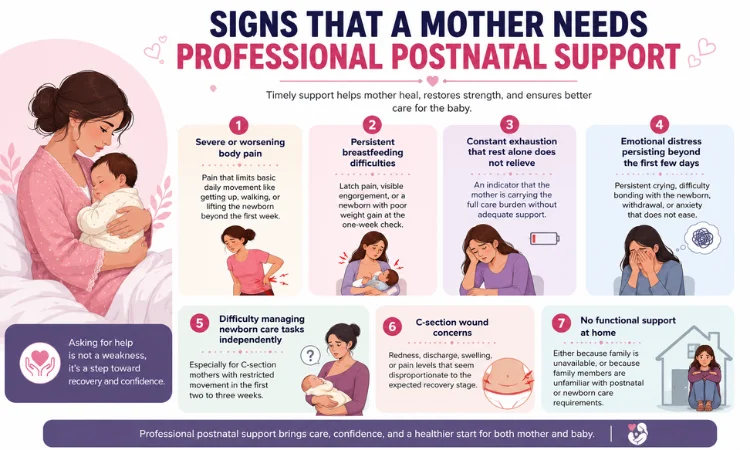
Many families underestimate the postnatal care load until it becomes visible as a problem. Seek professional support when any of the following are present:
- Severe or worsening body pain that limits basic daily movement — getting up, walking, or lifting the newborn — beyond the first week.
- Persistent breastfeeding difficulties: latch pain, visible engorgement, or a newborn with poor weight gain at the one-week check.
- Constant exhaustion that rest alone does not relieve — an indicator that the mother is carrying the full care burden without adequate support.
- Emotional distress persisting beyond the first few days: persistent crying, difficulty bonding with the newborn, withdrawal, or anxiety that does not ease. These are clinical indicators, not personal weakness.
- Difficulty managing newborn care tasks independently — particularly for C-section mothers with restricted movement in the first two to three weeks.
- C-section wound concerns: redness, discharge, swelling, or pain levels that seem disproportionate to the expected recovery stage.
- No functional support at home — either because family is unavailable, or because family members are unfamiliar with postnatal or newborn care requirements.
How to Choose the Right Postnatal Care Service at Home
Not all home care providers offer the same level of training, cultural sensitivity, or availability. Six things to verify before confirming a provider:
- Verify postnatal-specific caregiver experience. Confirm the caregiver has worked with post-delivery mothers and newborns specifically — not only with elderly or post-surgical patients.
- Confirm hygiene protocols before first visit. Ask about hand hygiene practice, caregiver health screening, and any sanitisation steps before entering your home.
- Request a care plan tailored to your delivery type. A reliable provider adjusts the schedule and tasks for normal delivery versus C-section recovery. A fixed package that ignores delivery type is a warning sign.
- Check 24/7 availability and backup arrangements. Postnatal emergencies — high fever, unusual wound changes, newborn breathing concerns — occur at night. Confirm off-hours support and caregiver backup.
- Review local testimonials from Mangalore-area families. Cultural familiarity with coastal Karnataka’s postnatal practices — dietary traditions, hygiene norms, family dynamics — directly affects care quality.
- Confirm structured family communication. Choose a provider who gives regular updates on the mother’s and baby’s condition — not only at the end of each shift.
Conclusion – The Six Weeks That Set the Recovery Baseline
The first six weeks after delivery set the physical, emotional, and relational baseline for both mother and newborn. For nuclear family households in Mangalore — where traditional joint-family support may not be available, where C-section rates are rising, and where 22% of Indian mothers face postpartum depression without diagnosis or support — the case for professional postnatal care at home is not a lifestyle choice. It is a clinically grounded response to a genuinely demanding recovery window.
Home-based professional care from Mahara Home Care brings background-verified caregivers to the family’s own home — covering postnatal care for mother recovery, newborn care, breastfeeding support, and emotional presence, across Mangalore, Kadri, Balmatta, and Kankanady. The mother recovers where she lives. The newborn adjusts where the family already is.
Looking for trusted postnatal care in Mangalore? Mahara Home Care provides professional support for new mothers and newborns — experienced, background-verified caregivers, personalised recovery plans, and 24/7 availability across Mangalore, Kadri, Balmatta, and Kankanady. Call / WhatsApp: +91 7204439333 | Email: info@mahara-home-care
Frequently Asked Questions
1. What is postnatal care at home?
Postnatal care at home is professional caregiving support — physical, nutritional, emotional, and newborn-focused — delivered in the mother’s home during the six weeks after delivery. The WHO recommends at least four postnatal contacts within this window. A trained caregiver covers physical recovery, newborn hygiene and feeding, breastfeeding guidance, and daily health monitoring — without the mother needing to travel to a clinic.
2. How long is postnatal care needed after delivery?
The WHO recommends structured postnatal monitoring and at least four contacts within the first six weeks. For C-section recovery, the intensive support period typically extends to six to eight weeks depending on wound healing. The first two weeks are most demanding in terms of practical care needs.
3. Is postnatal care important after a normal delivery?
Yes. Even after a normal delivery, the mother faces perineal healing, hormonal fluctuations, breastfeeding challenges, and sleep deprivation at the same time. Research published in ScienceDirect (2021, 20,043 Indian mothers) estimates that approximately 22% of Indian mothers experience postpartum depression — a rate that drops with structured professional support during recovery.
4. Can postnatal caregivers help with newborn care?
Yes. Professional postnatal caregivers assist with newborn bathing, diaper changing, breastfeeding positioning and latch support, burping, safe sleep positioning, and monitoring for health signs such as jaundice, umbilical cord healing, feeding pattern changes, and weight gain. They also guide first-time parents through daily newborn care routines with confidence.
5. Why choose postnatal care at home instead of hospital visits?
Home-based postnatal care eliminates the need to transport a recovering mother and newborn to a hospital, reduces infection exposure, provides continuous one-on-one support rather than scheduled appointments, and supports emotional recovery in familiar surroundings. The WHO acknowledges that home-based postnatal monitoring improves outcomes where clinic attendance post-discharge is difficult.
About the Author
Vijesh Kumar is a co-founder of Mahara Home Care with experience in home healthcare and patient support services. He focuses on providing reliable, compassionate care solutions for elderly people, patients, and families across Udupi, Manipal, Mangalore, Mysore and nearby areas.