
 Medical Disclaimer: This article is for informational purposes only and does not constitute medical or professional healthcare advice. Physiotherapy interventions for elderly patients should always be prescribed, supervised, and monitored by a qualified, registered physiotherapist. Consult a licensed healthcare provider before starting any home physiotherapy programme.
Physical therapy at home services bring trained physiotherapists directly to elderly patients in their own homes — eliminating the physical burden of travel for senior citizens who struggle with mobility, pain, or post-surgical recovery. For India’s growing elderly population, this model of care is not a luxury option: it is increasingly a clinical and practical necessity. India’s population of senior citizens aged 60 and above was estimated at 103.8 million in the 2011 Census of India and is projected to grow significantly through 2031 and beyond, according to data from the Ministry of Statistics and Programme Implementation. The The conditions that make home physiotherapy most relevant are familiar to any Indian family caring for elderly parents: arthritis that makes every step painful, the slow functional recovery after a knee or hip replacement, the daily challenge of Parkinson’s disease or stroke-related mobility limitations, and the constant worry of falls that could turn a manageable situation into a hospitalisation.
This article explains what professional physical therapy for elderly at home involves, what conditions it addresses, how it improves independence and quality of life, and what families in Mangalore and across India should look for when choosing a home physiotherapy provider.
What Are Physical Therapy at Home Services?
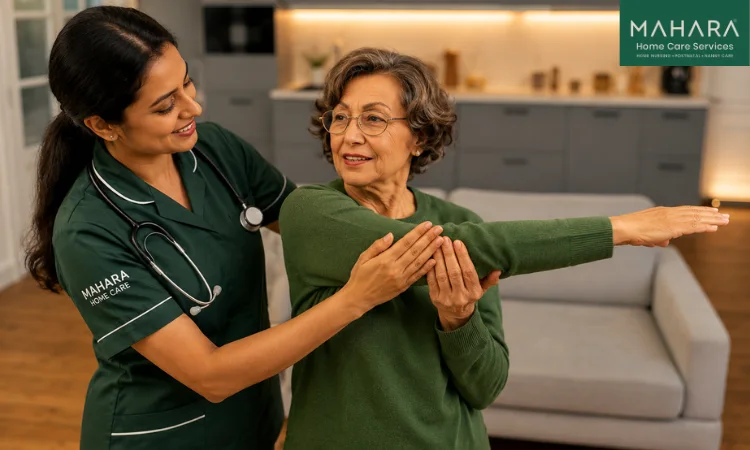
Home physio for elderly patients is a model of physiotherapy delivery where a qualified physiotherapist — holding a Bachelor of Physiotherapy (BPT) or Master of Physiotherapy (MPT) degree — visits the patient at home to assess, design, and deliver a personalised treatment programme. The therapist brings the clinical expertise; the patient’s home environment is the treatment setting.
This is fundamentally different from clinic physiotherapy in both logistics and clinical approach. At a clinic, the therapist works with the patient in a generalised space and often moves between multiple patients. At home, the therapist has full visibility of the patient’s actual living environment — the stairs they must climb, the chair they sit in for hours, the bathroom they must reach safely — and designs the treatment programme around these real-world functional requirements.
| Factor | Clinic Physiotherapy | Home Physiotherapy |
| Travel requirement | Patient must travel to clinic — difficult for mobility-impaired elderly | No travel — therapist comes to the patient’s home |
| Environment | Unfamiliar clinical setting; shared equipment | Patient’s own familiar home — reduced anxiety |
| Family involvement | Limited — family waits outside or drops off | Active — family present, learning care techniques |
| Schedule flexibility | Fixed clinic hours; waiting time common | Flexible — sessions timed to patient’s daily routine |
| Session personalisation | Time-limited; therapist shared across multiple patients | Full one-to-one attention in the patient’s home context |
| Post-session rest | Travel required after session — tiring for elderly | Immediate rest in own bed or chair |
| Infection and safety risk | Higher — clinical environment exposure during travel | Lower — controlled home environment |
Why Elderly Patients Need Physical Therapy
Ageing brings predictable physical changes: muscle mass decreases, joint cartilage wears down, balance mechanisms become less reliable, and recovery from illness or surgery slows. These changes are not inevitable in their severity — structured physiotherapy intervention directly modifies their trajectory.
The LASI Wave 1 survey found that a significant proportion of elderly Indians experience functional limitations in daily activities — walking, climbing stairs, standing for extended periods, and managing personal hygiene independently. These limitations are not simply accepted outcomes of age. They are conditions that physical therapy for seniors at home is specifically trained and equipped to address.
Conditions That Require Physiotherapy Intervention in Elderly Patients
| Condition | How Home Physiotherapy Helps |
| Arthritis (OA/RA) | Gentle joint mobilisation, muscle strengthening, pain management to reduce stiffness and improve daily movement |
| Post-stroke recovery | Limb movement rehabilitation, balance training, functional activity retraining to restore independence progressively |
| Knee replacement recovery | Graduated weight-bearing exercises, range of motion work, walking confidence training at home |
| Hip surgery recovery | Safe mobility training, transfer techniques, stair negotiation, strengthening to support healing |
| Parkinson’s disease | Balance and gait exercises, fall prevention training, coordination work, posture support |
| Osteoporosis | Weight-bearing exercises appropriate to bone density, posture correction, fall prevention strategies |
| Back and neck pain | Stretching, posture correction, core stabilisation, pain relief techniques without medication dependence |
| Balance and gait disorders | Vestibular rehabilitation, coordination training, assistive device guidance (walker/cane use) |
| COPD / breathing difficulties | Respiratory physiotherapy, breathing exercises, chest clearance techniques for improved lung function |
Conditions listed are commonly addressed through physiotherapy. Treatment approach is determined by the treating physiotherapist after individual assessment. This is not a medical diagnosis guide.
Early physiotherapy intervention — beginning as soon as a condition is diagnosed or a surgery is completed — produces better functional outcomes than delayed treatment. For stroke recovery in particular, the neuroplasticity that physiotherapy activates and supports is most responsive in the weeks immediately following the event. Later-stage physiotherapy also produces meaningful improvements — the timing of intervention affects the rate and ceiling of recovery, not whether rehabilitation is worthwhile. Delayed rehabilitation means missed opportunity for the fastest possible recovery window.
The goal of physiotherapy for elderly patients is not to restore a 70-year-old to the physical capacity of a 30-year-old. It is to optimise functional independence within the patient’s current physiological state — helping them walk safely to the kitchen, stand from a chair without pain, climb the steps to their home, and manage daily personal care without full dependence on others. For Indian families caring for elderly parents, this functional independence directly reduces the caregiving burden while preserving the elder’s dignity and confidence.
Major Benefits of Physical Therapy for Seniors at Home
1. Improves Mobility and Flexibility
Physical therapy at home services address joint stiffness, muscle tightness, and reduced range of motion — the physical limitations that make daily movement difficult for elderly patients. Structured exercise programmes gradually restore the flexibility that allows seniors to walk more comfortably, rise from sitting without assistance, and manage stairs with greater confidence.
For elderly patients who have reduced activity due to pain or fear of falling, physiotherapy interrupts the cycle of inactivity that accelerates physical decline. Regular guided movement — even gentle, carefully graded exercises — maintains the joint health and muscle function that independent living requires. The physiotherapist adjusts the intensity and duration of every session to the patient’s current capacity, increasing progressively as ability improves.
2. Reduces Pain Without Medication Dependence
Chronic pain management in elderly patients is a complex clinical challenge — many seniors are already on multiple medications, and adding analgesics carries real risks of drug interactions and side effects. Home physio for elderly provides an evidence-based alternative through manual therapy techniques, targeted exercise, heat and cold application, TENS (transcutaneous electrical nerve stimulation) where indicated, and postural correction that reduces the mechanical load causing pain.
For arthritis — India’s most prevalent musculoskeletal condition in elderly patients — physiotherapy’s role is to manage the symptom burden and preserve functional capacity, not to reverse the structural changes in the joint. Regular physiotherapy reduces the level of pain management medication required for many patients, and supports the effectiveness of what medication is prescribed.
3. Prevents Falls and Reduces Injury Risk
Fall prevention is a structured component of every home physiotherapy programme for elderly patients. A qualified physiotherapist assesses the patient’s balance, gait, muscle strength, and home environment to identify specific fall risks — and then addresses each one directly through targeted exercise and practical modifications.
The core techniques used in fall prevention physiotherapy include:
- Balance training: Single-leg standing, weight shifting, and coordination exercises that strengthen the body’s ability to recover from a stumble before it becomes a fall
- Lower limb strengthening: Targeted exercises for the quadriceps, hip abductors, and ankle muscles — the muscle groups most responsible for fall prevention in elderly patients
- Gait retraining: Correcting unsafe walking patterns, stride length, and foot placement that increase fall risk in elderly patients
- Home hazard guidance: The physiotherapist identifies environmental risks — loose rugs, poor lighting, low chairs, slippery bathroom floors — and advises practical modifications
Research consistently shows that structured exercise-based fall prevention programmes reduce fall incidence in elderly patients by 20–30%. For families caring for elderly parents in Mangalore, where many traditional homes have uneven flooring, steps between rooms, and wet bathroom surfaces, this targeted intervention is particularly valuable.
4. Faster Recovery After Surgery or Stroke
Post-surgical physiotherapy is not optional — it is the mechanism by which surgical outcomes are realised. A knee replacement that is not followed by structured physiotherapy rehabilitation produces a joint with restored anatomy but insufficient functional strength and range of motion for normal daily use. The surgery creates the structural opportunity; physiotherapy develops the functional outcome.
Consider a common scenario in Indian families: a 72-year-old patient returns home after knee replacement surgery. Hospital physiotherapy provides the immediate post-surgical protocol, but the patient is discharged within days. At home, without regular sessions, many patients develop stiffness, become fearful of weight-bearing, and allow the joint to stiffen in a position of comfort rather than a position of function. Physical therapy for elderly at home — delivered by a physiotherapist who knows the patient’s home environment, monitors their progress weekly, and adjusts the programme as healing advances — produces measurably different functional outcomes at three and six months post-surgery compared to no post-discharge rehabilitation.
5. Provides Emotional Comfort and Reduces Anxiety
The psychological dimension of physical recovery in elderly patients is clinically significant. Elderly patients who are recovering from stroke, major surgery, or a serious fall experience anxiety about their ability to return to normal function — and that anxiety itself impairs rehabilitation. Tension, fear of movement, and low motivation all slow physical recovery.
Being treated at home — in the bed they sleep in, surrounded by family, without the disorientation and clinical anxiety of a hospital environment — creates the psychological safety that supports active engagement with rehabilitation. Patients who are comfortable and motivated participate more fully in therapy sessions, adhere better to home exercise programmes, and progress more consistently than those who are distressed by their care environment.
6. Personalised One-on-One Care for Each Patient
No two elderly patients have the same physical condition, medical history, home environment, or recovery goals. A 78-year-old woman recovering from hip surgery who lives in a two-storey house has completely different rehabilitation requirements from a 68-year-old man with Parkinson’s disease who lives in a single-storey flat. Physical therapy at home services address this by design — the treatment plan is developed for one specific patient, in their specific home, with their specific goals.
The therapist visits the patient’s home, assesses the physical layout, understands the daily functional requirements, involves the family in understanding and supporting the home exercise programme, and adjusts the plan based on the patient’s response at each session. This level of individual attention is structurally impossible in a clinic setting where time and resources are shared across multiple patients simultaneously.
Common Physical Therapy Treatments Provided at Home
The specific techniques used in home physiotherapy sessions depend on the patient’s diagnosis, condition severity, and rehabilitation goals. Qualified physiotherapists draw from a range of treatment approaches:
-
- Exercise therapy: Graded strengthening and range-of-motion programmes specific to the patient’s condition and capacity
-
- Manual therapy: Hands-on joint mobilisation and soft tissue work for pain management and flexibility
-
- Balance and gait training: Structured exercises and walking practice to improve stability and reduce fall risk
-
- Post-surgical rehabilitation: Graduated weight-bearing, range of motion recovery, and functional retraining after knee or hip surgery
-
- Stroke rehabilitation support: Limb movement exercises, transfer training, and functional activity retraining
-
- Respiratory physiotherapy: Breathing exercises, chest clearance techniques for elderly patients with COPD or post-illness lung weakness
-
- Fall prevention exercises: Specific balance, strength, and coordination work targeting the muscle groups responsible for fall prevention
-
- Assistive device training: Teaching elderly patients to use walkers, canes, or other mobility aids safely and effectively
-
- Pain management techniques: TENS, heat and cold therapy, and postural correction to manage chronic pain without medication increase
Practical example: An elderly patient returns home after knee replacement surgery. In the first week, the physiotherapist focuses on gentle range-of-motion exercises, safe transfer techniques (getting in and out of bed, on and off a chair), and monitoring the surgical wound site. By week three, the sessions progress to standing balance work and assisted walking practice. By week six, the patient is practising stair climbing and outdoor walking with increasing confidence. At week twelve, the patient is managing most daily activities independently — with the physiotherapist providing a maintenance programme and discharge planning. The family, having participated in sessions throughout, understands how to support safe movement at home between visits.
How Home Physiotherapy Improves Quality of Life for Elderly Patients
The clinical outcomes of physiotherapy — improved mobility, reduced pain, better balance — translate directly into quality of life improvements that Indian families observe daily. These are the changes that matter at home: the grandfather who can walk to the prayer room again, the mother who can bathe independently, the father who can sit with the family at the dinner table without being lifted.
5 Quality of Life Changes Families Observe with Regular Physiotherapy
-
- Maintained independence in daily activities: Patients who receive regular physiotherapy retain the functional capacity to manage personal hygiene, dressing, eating, and simple household movement without full dependence on family caregivers. This independence has both practical value (reduced caregiving load on family members) and profound psychological value for the elderly patient.
-
- Improved sleep quality and reduced fatigue: Chronic pain and restricted movement impair sleep in elderly patients. As physiotherapy reduces pain and improves physical confidence, sleep quality typically improves — which in turn accelerates physical recovery and emotional wellbeing in a positive reinforcing cycle.
-
- Reduced emergency hospital visits: Patients who receive regular physiotherapy for fall prevention, mobility maintenance, and post-surgical rehabilitation are less likely to experience the acute events — falls, joint deterioration, post-surgical complications — that result in emergency hospital admissions. For families managing the care of elderly parents in Indian homes, reducing hospital visits reduces both financial burden and family stress.
-
- Better social engagement and mental health: An elderly patient who can move confidently and manage daily activities independently maintains social engagement — visiting family members, participating in religious activities, talking to neighbours. Physical limitation that restricts movement frequently leads to social isolation and depression. Physiotherapy addresses the physical root of this limitation.
-
- Reduced caregiver burden: Family members who provide informal care to elderly parents benefit when professional physiotherapy is part of the care plan. The therapist trains the family in safe handling techniques, home exercise support, and fall prevention measures — turning family members from anxious bystanders into confident, effective care partners.
Why Families Prefer Physiotherapy at Home Services in Mangalore
Mangalore and the surrounding Dakshina Kannada district have a well-established tradition of family-based elder care, with most elderly residents living within multi-generational households. As the elderly population grows and the conditions requiring structured rehabilitation become more prevalent, the demand for professional Physiotherapy at Home Services in Mangalore has grown correspondingly.
Several practical factors make home physiotherapy specifically well-suited to Mangalore’s elderly population:
-
- Many elderly residents live in traditional homes with multiple floors, where travel to a clinic requires navigating stairs before the session has even begun — a barrier that home visits eliminate
-
- The coastal climate of Dakshina Kannada, with high humidity and seasonal monsoon conditions, makes travel physically demanding and potentially risky for elderly patients with joint conditions or reduced mobility
-
- Mangalore’s dispersed residential geography means clinic distances vary significantly; home visits remove location as a variable in care access
-
- Family structures in coastal Karnataka typically involve adult children who work full-time and cannot regularly accompany elderly parents to clinic appointments — home visits fit within family work schedules more practically
For families in Mangalore seeking professional home physiotherapy, Mahara Home Care provides professional physiotherapy and home healthcare services across Mangalore, with a focus on elderly rehabilitation, mobility support, and post-surgical recovery care.
Tips for Choosing the Right Home Physiotherapy Service
Not all home physiotherapy providers deliver the same standard of care. The criteria below help families evaluate providers objectively — moving past marketing claims to assess actual service quality:
| What to Verify | What to Ask the Provider | Red Flag |
| Physiotherapist qualifications | Does the physiotherapist hold a BPT or MPT degree? Are they registered with a recognised professional body? | Credentials not provided when asked; no registration details |
| Elderly care experience | Do they have specific experience treating elderly patients with arthritis, stroke recovery, or post-surgical rehabilitation? | No stated elderly-specific experience; only general physiotherapy background |
| Initial assessment before treatment | Is a home assessment conducted before the treatment plan is prepared? Does the plan account for the patient’s home environment? | Generic programme offered without any prior patient assessment |
| Safety and hygiene standards | What infection control and safety protocols do they follow for home visits? Do they carry their own equipment? | No mention of hygiene protocols; no documented safety procedures |
| Progress reporting to family | How is the patient’s progress tracked and communicated to family members? | No structured progress monitoring; no family updates |
| Emergency protocol | What is the protocol if the patient has an adverse event or medical emergency during a session? | No documented emergency response plan |
Use this checklist when meeting or calling prospective providers. Request written confirmation of key details — particularly qualifications, treatment plan process, and emergency protocol.
One additional consideration specific to Indian households: ask whether the physiotherapist is comfortable communicating in Kannada or the patient’s preferred language. For elderly patients — particularly those who are anxious, in pain, or recovering from a neurological event — receiving instructions and reassurance in a familiar language meaningfully affects their engagement with and benefit from therapy.
Conclusion
Physical therapy at home services give elderly patients access to clinical rehabilitation expertise in the environment where recovery actually happens — their own home. For Indian families managing the care of elderly parents with arthritis, post-surgical recovery needs, stroke-related limitations, or fall risk, home physiotherapy addresses the practical and emotional barriers that clinic-based care cannot.
The long-term advantages are specific and observable: better mobility means more independence; better balance means fewer falls; structured rehabilitation means faster recovery after surgery or acute illness; and the involvement of a trained professional means family caregivers have expert support rather than navigating complex care decisions alone.
The right provider is qualified, experienced with elderly patients, transparent about their approach, and invested in monitoring and communicating progress. These are the standards a family should hold any home physiotherapy provider to — and the standards that protect both the patient and the family.
Arrange Physiotherapy at Home for Your Elderly Loved Ones
Looking for trusted and professional Physical Therapy at Home Services for elderly family members? Mahara Home Care provides trained home physiotherapy and compassionate senior care services in Mangalore. From mobility support to post-surgical rehabilitation, their physiotherapists support elderly patients in recovering safely and maintaining independence at home. Visit maharahomecare.com to enquire about care for your loved one.
→ Enquire about home physiotherapy and senior care services — Mahara Home Care
→ View elderly rehabilitation and home care service details
Frequently Asked Questions
Q1: What are Physical Therapy at Home Services?
Physical therapy at home services involve qualified physiotherapists visiting elderly patients in their own homes to deliver personalised rehabilitation and mobility support. The therapist conducts an initial assessment, designs a treatment programme suited to the patient’s condition and home environment, and delivers sessions in the patient’s familiar home setting — eliminating the need for travel to a clinic.
Q2: How does home physiotherapy help elderly patients?
Physical Therapy at Home Services helps elderly patients by improving joint mobility and muscle strength, reducing chronic pain from arthritis and post-surgical recovery, preventing falls through balance and coordination training, supporting rehabilitation after stroke or major surgery, and building the functional independence that allows seniors to manage daily activities. The home setting means treatment is applied directly to the patient’s actual living environment.
Q3: Is physiotherapy at home safe for senior citizens?
Home physiotherapy is safe for senior citizens when delivered by a qualified physiotherapist — holding a BPT or MPT degree — who conducts a proper initial assessment before starting treatment. The home setting reduces travel risk for mobility-impaired elderly patients. Families should verify the therapist’s qualifications, ensure an assessment is conducted before treatment begins, and confirm the provider has a documented emergency protocol.
Q4: How often should elderly patients take physiotherapy sessions at home?
Session frequency depends on the patient’s condition, age, recovery stage, and treatment goals — determined by the treating physiotherapist after assessment. Post-surgical or stroke rehabilitation may require daily or several sessions per week in early stages. For maintenance and fall prevention in stable elderly patients, two to three sessions per week is a common starting schedule. Always follow the therapist’s prescribed plan rather than a generic frequency.
Q5: Can physiotherapy help after stroke recovery at home?
Yes. Physiotherapy is a core component of post-stroke rehabilitation and is effective when delivered at home. Home stroke rehabilitation includes limb movement exercises, balance and gait training, transfer techniques, and functional activity retraining for daily tasks. The home environment allows therapy to be directly applied to the patient’s actual living conditions — stairs, bathroom, furniture — rather than a generalised clinical space.
Q6: What conditions can be treated with home physiotherapy for elderly patients?
Home physiotherapy for elderly patients addresses arthritis, post-stroke recovery, knee and hip replacement rehabilitation, Parkinson’s disease motor symptoms, osteoporosis-related fall risk, chronic back and neck pain, balance and gait disorders, and COPD-related breathing difficulties through respiratory physiotherapy. The treating physiotherapist assesses the patient individually and designs the treatment approach for each specific condition.