
This article is educational and does not replace medical advice, diagnosis or treatment. A qualified physiotherapist should assess the patient before any exercise plan begins, and the treating doctor should be consulted about any change in condition.
Home care physiotherapy services help patients walk again by sending a qualified physiotherapist to the home to assess strength, balance and movement, set a personal exercise plan, supervise walking practice and track progress. The pace depends on the cause, general health and regular practice, so a physiotherapist’s assessment comes first.
Falls caused an estimated 842,000 deaths worldwide in 2023, and about 71% of them were among adults aged 60 and older, according to the World Health Organization. Walking is the skill that keeps a person out of that statistic. It carries a patient to the bathroom, the dining table and the front door. When surgery, stroke, injury, weakness or age takes it away, the family needs a plan, and home care physiotherapy services in Mangalore bring that plan to the patient’s own floors and stairs.
Need professional physiotherapy support at home? Visit Mahara Home Care to explore home care services and enquire about suitable support for your family’s needs.
Emergency first. Sudden weakness on one side, trouble speaking, chest pain, severe breathlessness or a fall with a suspected fracture need emergency care. Call 112, or 108 for an ambulance. Physiotherapy at home does not replace emergency response.
What Are Home Care Physiotherapy Services?
Home care physiotherapy services deliver rehabilitation at the patient’s residence. A physiotherapist, a professional trained in movement and function, assesses the patient and treats with exercise, walking practice, balance work and, where suitable, manual therapy. Mahara’s physiotherapy page lists physiotherapists with BPT or MPT credentials, the bachelor’s and master’s degrees in physiotherapy.
Search results use several labels for the same service, such as physiotherapy at home services in Mangalore, physical therapy home health or physiotherapy in home care. The name changes; the essentials do not: an assessment, a personalised plan, supervised practice and regular review.
Personalisation matters because two patients with the same diagnosis can differ in strength, balance, pain, home layout and family support. A plan copied from a leaflet ignores all of that.
For booking, conditions treated and rates, see Mahara’s dedicated physiotherapy service page. Mahara’s guide for elderly patients includes its own section on physical therapy at home services for older adults. This article stays with walking recovery.
Why Do Patients Find It Difficult to Walk?
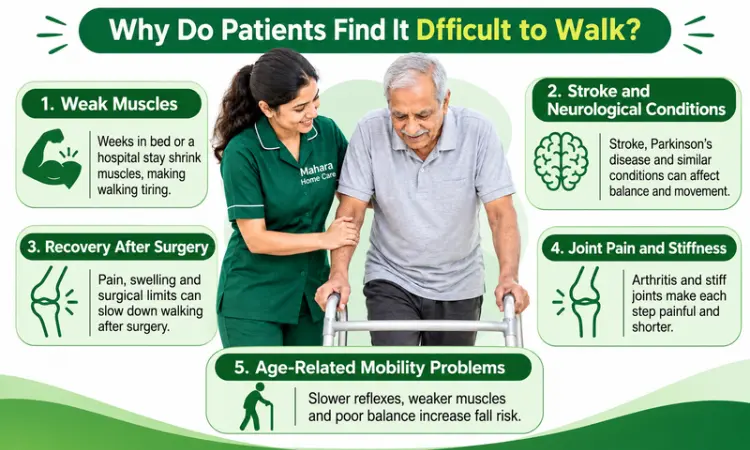
Walking needs strength, balance, joint movement, nerve control and confidence to work together, and weakness in any one breaks the chain.
1. Weak Muscles
Weeks in bed or a hospital stay shrink the thigh, hip and calf muscles that lift and steady the body. A patient may stand but tire after a few steps, or avoid walking from fear of falling.
2. Stroke and Neurological Conditions
Stroke, Parkinson’s disease and similar conditions can weaken one side, disturb balance or slow the signal from brain to limb. These cases need a doctor’s diagnosis and a therapist trained in neurological care.
3. Recovery After Surgery
After knee, hip or spinal surgery, pain, swelling and the surgeon’s limits decide how much weight the patient may bear. Follow the surgeon’s instructions on walking aids and limits; the physiotherapist progresses within them. Mahara’s post-surgery care at home page covers the nursing side.
4. Joint Pain and Stiffness
Arthritis and stiff joints shorten the step and make stairs painful. Pain makes patients move less, and less movement stiffens joints further.
5. Age-Related Mobility Problems
Slower reflexes, weaker muscles and poorer balance raise fall risk. The WHO fact sheet recommends exercises matched to the person that challenge balance and improve functional strength, and cites a Cochrane review in which exercise reduced the overall rate of falls by approximately 23%.
How Can Home Care Physiotherapy Help Patients Walk Again?
A physiotherapist works on the parts of walking that have failed, in an order the patient can manage.
| Goal | What the physiotherapist works on | What families may notice |
| Muscle strength | Graded strengthening of hips, thighs and calves | Standing from a chair needs less help |
| Balance and stability | Weight shifting, standing balance, safe turning | Fewer wobbles when turning or reaching |
| Gradual walking practice | Supervised steps with the right aid, progressed as tolerated | Longer walks with fewer rests |
| Joint movement | Movement work within pain and surgical limits | Less stiffness on waking |
| Coordination | Step length, rhythm and weight transfer | A steadier, more even pace |
| Confidence | Practice of real tasks: bathroom, doorway, stairs | The patient attempts daily tasks without hesitation |
Results vary, and no physiotherapist can promise a date for independent walking. The evidence for home rehabilitation is encouraging but uneven. A Cochrane review of 14 trials with 1,617 stroke patients found that home therapy services appear to improve independence in personal activities of daily living, while stating that the amount of benefit is uncertain. The review dates from 2003, so read it as one data point, not a verdict.
What Happens During a Home Physiotherapy Session?
Mahara’s physiotherapy page describes five steps, given here as the company’s own account of its process.
1. Initial consultation: a coordinator calls to discuss the diagnosis, the condition and the home environment.
2. Plan: the physiotherapist reviews discharge summaries and imaging, then sets goals and visit frequency.
3. First visit: an assessment of strength, range of motion and balance, with a neurological screening.
4. Sessions: 45 to 60 minutes, three to five a week, with intensity rising gradually.
5. Progress monitoring: weekly notes shared with the family and the treating physician, and the plan adjusted at milestones.
Ask the therapist to show the family each exercise, the safe way to assist it and what to practise between visits. Written instructions beat memory.
What Does Home Physiotherapy Cost in Mangalore?
Mahara publishes indicative rates as of May 2026, including 18% GST. Stroke, spinal surgery and complex cases may differ, and the final quote follows the assessment.
| Service | Session length | Per session | 10-session package |
| Orthopedic | 45 to 60 minutes | ₹900 | ₹7,500 |
| Neurological | 45 to 60 minutes | ₹1,000 | ₹8,500 |
| Post-surgical | 45 to 60 minutes | ₹1,000 | ₹8,500 |
| Geriatric | 45 to 60 minutes | ₹850 | ₹7,000 |
As an illustration with these figures, a post-surgical patient seen four times a week for six weeks needs 24 sessions, about ₹24,000 at the single-session rate, before any package pricing.
Who Can Benefit From Home Care Physiotherapy Services in Mangalore?
Who Is a Good Fit?
Patients leaving hospital after joint replacement or spinal surgery, stroke survivors, people with Parkinson’s disease, patients with arthritis or chronic pain, and older adults with weak balance or low stamina. Physio at home for elderly patients suits those for whom a clinic trip is tiring or risky; Mahara’s elder care services sit alongside it. A patient who is unwell, in acute pain or not yet cleared to exercise should speak to the doctor first.
What Are the Benefits of Physiotherapy at Home in Mangalore?
The therapist sees the actual bathroom threshold, staircase and bed height, so practice matches the obstacles the patient meets. There is no travel after surgery or stroke, and family members can watch and learn. The trade-off is equipment: a clinic has fixed machines, while a home visit relies on what the therapist brings.
Families searching for home care physiotherapy near me should ask for the exact locality. Mahara’s physiotherapy page lists Kadri, Kankanady, Balmatta, Bejai and nearby areas of Mangalore, and Udupi. Confirm your address before booking.
When Is a Home Visit Not Enough?
Call the treating doctor, or 112 for emergency services, for sudden weakness on one side or trouble speaking, chest pain, severe breathlessness, a fall with a suspected fracture, fever, a surgical wound that is red, swollen or leaking, or a painful swollen calf. Tell the physiotherapist about new pain, dizziness or swelling before the next exercise.
How Long Does It Take for a Patient to Walk Again?
No honest answer is a single number. The pace depends on the cause, since a hip replacement and a major stroke follow different courses; the time since the event; general health, including heart, lungs, diabetes and nutrition; pain and surgical limits; memory and mood; how regularly the patient practises; and the help available at home.
Mahara’s physiotherapy page FAQ says post-surgical patients typically need three to five sessions a week for four to eight weeks, while neurological and chronic pain cases may need ongoing monthly maintenance. These are the company’s figures, not a promise for any patient.
Ask the physiotherapist for goals in steps, such as standing from a chair without hands, then walking to the bathroom with a frame, reviewed at each milestone. Two patients with the same operation can progress at different speeds because of age, earlier strength, pain and practice. Compare a patient with their own last week, not with a neighbour.
How Can Families Support a Patient’s Walking Recovery at Home?
Clear loose rugs and cables, light the route to the bathroom, use non-slip footwear and keep the walking aid within reach. WHO’s fact sheet reports that home fall-hazard assessment and modification reduced falls by 38% in higher-risk groups. Encourage the prescribed exercises, note what was practised and praise small gains. Never lift or pull a patient to make them walk unless the physiotherapist has shown the safe method, and do not push past pain.
How to Choose the Right Home Physiotherapy Service in Mangalore
Condition-specific rehabilitation matters: a stroke plan and a knee-replacement plan differ, and a professional adjusts exercises as the patient changes, keeping safety ahead of speed. Put the same six checks to every provider.
| Check | A good answer | A warning sign |
| Qualification and registration | Degree (BPT or MPT) and registration details in writing | “Certified” with no detail |
| Initial assessment | A full assessment visit before the plan | A plan quoted by phone only |
| Personalised plan | Written goals tied to the diagnosis and the home | One routine for every patient |
| Progress monitoring | Regular written updates for family and doctor | No records |
| Caregiver guidance | The therapist shows the family safe assistance | The family is left to guess |
| Visits and charges | Timings, area, session and package rates with GST in writing | Verbal rates, no area confirmation |
On qualifications, the National Commission for Allied and Healthcare Professions Act, 2021 lists physiotherapy as a recognised category, with a baccalaureate degree as the minimum qualification, and provides for central and state registers of professionals. Ask which register entry applies to your therapist, keep a copy of the degree certificate, and treat an unclear answer as a reason to look elsewhere.
Walking Again Starts With an Assessment
Home care physiotherapy services support walking rehabilitation through assessment, a personal plan, supervised practice and regular review. Professional guidance and steady practice set the pace, and no one can promise a date. Ask the doctor before starting, seek a qualified physiotherapist’s assessment, and aim for safe, personalised goals.
Looking for home care support for your loved ones in Mangalore? Visit Mahara Home Care to learn more about its services and enquire about suitable care options.
Frequently Asked Questions
Can home physiotherapy help a stroke patient walk again?
It can support recovery, but outcomes vary with the severity of the stroke, the time since it happened and general health. The doctor should confirm the patient is stable, and a physiotherapist trained in neurological rehabilitation should plan the exercises. Expect gradual, goal-based progress, and do not accept a promised date for independent walking.
How many home physiotherapy sessions are needed after knee or hip surgery?
The surgeon’s protocol and the physiotherapist’s assessment decide. Plans often begin with several sessions a week and reduce as strength and walking improve. Ask for review points in writing, and follow the surgeon’s limits on weight-bearing and walking aids at every stage.
Is physiotherapy at home as effective as clinic physiotherapy?
For many patients it can be, but the evidence differs by condition. A Cochrane review of home therapy after stroke found improved independence in daily activities, though it is dated and the size of the benefit is uncertain. Clinics have fixed equipment; home visits suit patients for whom travel is tiring or unsafe.
What should I ask before booking a home physiotherapist?
Ask for the therapist’s degree and registration details, whether an assessment visit comes first, how the plan is personalised, how progress is recorded and shared with the doctor, which areas the provider covers, and the per-session and package charges in writing, including GST.
Is home physiotherapy safe for an elderly parent who fears falling?
It can be, when a qualified physiotherapist assesses balance and the home first and supervises every walking session. Remove trip hazards, keep the walking aid within reach and report any fall, dizziness or new pain to the doctor. WHO recommends exercises matched to the person that challenge balance and improve functional strength.
This article does not replace medical advice, diagnosis or treatment. For any concern about a patient’s health, consult their doctor. In an emergency, call 112, or 108 for an ambulance.
About the Author
• Vijesh Kumar is a co-founder of Mahara Home Care with experience in home healthcare and patient support services. He focuses on providing reliable, compassionate care solutions for elderly people, patients, and families across Udupi, Manipal, Mangalore, Mysore and nearby areas. About Mahara Home Care
• Reviewed by: L K Monu Borkala is a digital marketing strategist with 20+ years of experience producing informational content across healthcare services, home care, and professional services verticals. He is not a licensed clinician; this review covers content accuracy, tone and compliance with editorial standards, not clinical guidance.