This article is for informational purposes only and does not constitute medical or professional care advice. Consult a qualified healthcare professional or licensed home care agency before making any care decisions.
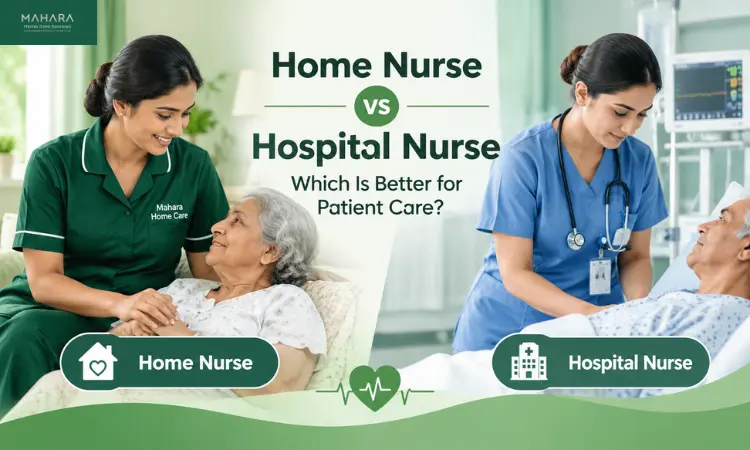
In the home nurse vs hospital nurse choice, neither is better for every patient. A hospital nurse works beside doctors, diagnostics and emergency equipment, so serious or unstable illness belongs there. A home nurse gives one-to-one attention in familiar surroundings, which suits medically stable patients once the treating doctor agrees. The patient’s condition decides, not preference Of every 100 patients in acute-care hospitals, seven in high-income countries and 15 in low- and middle-income countries acquire at least one health care-associated infection during their stay, according to the World Health Organization. Figures like that make families ask whether a recovering parent could be nursed at home. Sometimes the answer is yes, sometimes no. This guide sets the two roles side by side, shows where each wins, and explains how to check a home nurse before one enters the house.
Exploring nursing support at home? Read about home nursing and patient care services at Mahara Home Care.
What Does a Home Nurse Do, and What Does a Hospital Nurse Do?
What does a home nurse do?
A home nurse delivers nursing care at the patient’s residence, usually for one patient at a time. Typical tasks are giving prescribed medication, dressing wounds, recording vital signs and supporting recovery after surgery. For elderly patients and people with limited mobility, the nurse also helps with positioning, hygiene and meals. What a given nurse may do depends on qualification, the care plan and the patient’s medical needs. Mahara’s Mysore page says clinical procedures are supported only when appropriately qualified staff are available.
Who can benefit from a home nurse?
• Elderly patients who need nursing assistance
• Patients recovering after hospital discharge
• Bedridden patients whose condition is stable
• Patients who need professional care while staying at home
What does a hospital nurse do?
A hospital nurse works inside a department, such as a ward, operating theatre or intensive care unit, as part of a team with doctors, pharmacists and technicians. The job covers patient monitoring, prescribed medication, assisting procedures and coordinating with doctors. Each nurse looks after several patients in a shift, and the number depends on the hospital and the ward.
Home Nurse vs Hospital Nurse: What Is the Difference?
| Factor | Home nurse | Hospital nurse |
| Attention | One patient for the whole shift | Several patients in a shift |
| Setting | Patient’s own room and routine | Ward, ICU or theatre |
| Medical backup | Doctor by visit or call; ambulance if needed | Doctors, labs, imaging and emergency team on site |
| Family role | Present daily, can learn the routine | Bound by visiting hours |
| Privacy and comfort | Own bed, home food, no shared ward | Shared or single room, hospital routine |
| Scheduling | Day, night, 12-hour or 24-hour cover, agreed with the provider | Fixed hospital shifts and ward rules |
| Best suited to | Medically stable patients needing ongoing nursing | Acute, unstable or complex conditions |
Home nursing continues care; it does not substitute for treatment. A nurse at home can give prescribed medication, change dressings and watch vital signs, but cannot run tests, use equipment a ward holds or respond to a collapse the way an emergency team can.
When a Home Nurse Is the Better Fit
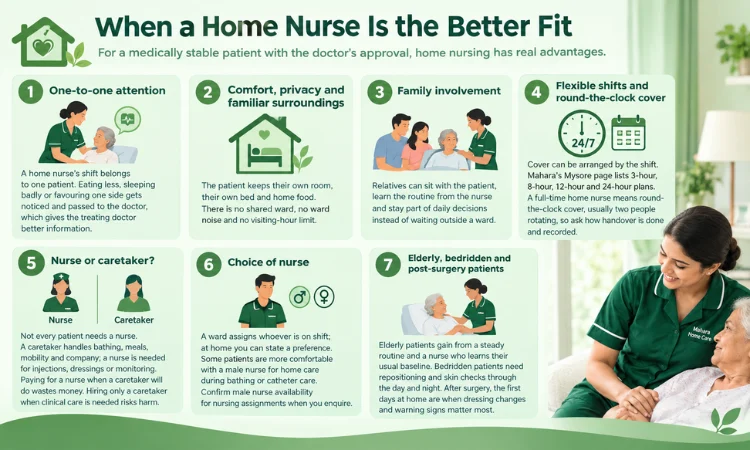
For a medically stable patient with the doctor’s approval, home nursing has real advantages.
1. One-to-one attention
A home nurse’s shift belongs to one patient. Eating less, sleeping badly or favouring one side gets noticed and passed to the doctor, which gives the treating doctor better information.
2. Comfort, privacy and familiar surroundings
The patient keeps their own room, their own bed and home food. There is no shared ward, no ward noise and no visiting-hour limit.
3. Family involvement
Relatives can sit with the patient, learn the routine from the nurse and stay part of daily decisions instead of waiting outside a ward.
4. Flexible shifts and round-the-clock cover
Cover can be arranged by the shift. Mahara’s Mysore page lists 3-hour, 8-hour, 12-hour and 24-hour plans. A full-time home nurse means round-the-clock cover, and that usually means two people rotating, so ask how handover between them is done and recorded. See also Mahara’s guide to hiring a full-time nurse.
5. Nurse or caretaker?
Not every patient needs a nurse. A caretaker for patient at home handles bathing, meals, mobility and company; a nurse is needed when tasks are clinical, such as injections, dressings or monitoring. Paying for a nurse when a caretaker will do wastes money. Hiring only a caretaker when clinical care is needed risks harm. For the non-clinical side, Mahara’s full-time vs part-time caretaker guide covers choosing a caretaker at home in Mysore by hours and need.
6. Choice of nurse
A ward assigns whoever is on shift; at home you can state a preference. Some patients are more comfortable with a male nurse for home care during bathing or catheter care. Mahara’s Mysore page says male or female caregivers are offered, matched to patient comfort, so confirm male nurse availability for nursing assignments when you enquire.
7. Elderly, bedridden and post-surgery patients
Elderly patients gain from a steady routine and a nurse who learns their usual baseline. Bedridden patients need repositioning and skin checks through the day and night, which Mahara’s guide to bedridden patient support in Mysore covers in depth. After surgery, the first days at home are when dressing changes and warning signs matter most, and the nurse works from the surgeon’s discharge instructions.
When Is Hospital Nursing the Better Choice?
Hospital care wins whenever safety depends on something a home cannot supply. The treating doctor decides, but this table shows the usual dividing line.
| Situation | Better setting | Why |
| Sudden trouble breathing, chest pain, seizure, heavy bleeding, cannot be woken | Hospital; call 112 first | Needs an emergency team, not a nurse visit |
| Unstable condition needing continuous monitoring | Hospital | Specialised equipment and doctors on site |
| Major surgery, first period after the operation | Hospital, as the surgeon advises | Observation for complications |
| Tests, imaging or procedures planned | Hospital | Facilities are not available at home |
| Stable after discharge, doctor agrees | Home nurse | Ongoing nursing without a ward bed |
| Long-term bedridden or elderly patient, condition stable | Home nurse, under a doctor’s plan | Daily nursing over weeks or months |
If the patient has sudden trouble breathing, chest pain, cannot be woken or worsens quickly, call 112 first, then the nurse and the family doctor. A home nurse is not an emergency responder.
Home nursing becomes appropriate after hospital treatment, once the patient is medically stable and the treating doctor approves. Moving a patient home before the doctor agrees, to save money, risks a return trip to the emergency room.
Is Home Nursing Cheaper Than Hospital Care?
For the right patient it can be, but the comparison is rarely like for like. A hospital bill bundles a bed, doctors, tests and treatment. A home nursing bill covers the nursing hours and services agreed in the care scope.
What drives home nursing cost?
Shift length, the nurse’s qualification, the procedures needed and the complexity of the patient’s care. Mahara’s Mysore page publishes indicative rates and states that the final rate depends on the caregiver’s experience level and how complex the care is.
| Mahara care plan, Mysore | Indicative rate |
| Daytime care, 8 hours | ₹1,500 to ₹1,800 |
| Night duty, 12 hours (overnight supervision, medication) | ₹1,800 to ₹2,200 |
| 24-hour care, two caregivers | ₹4,000 to ₹5,500 per day |
What drives hospital expense?
Room charges, consultations, investigations, treatment and nursing services, all of which rise with the length of stay. Ask the hospital for an itemised estimate.
How can families compare costs?
• Request a clear price breakdown from both.
• Check which services each price includes.
• Compare against the care the patient actually needs.
• Confirm whether hospital facilities are still medically necessary.
Home nursing may reduce certain expenses for a suitable patient, such as a long recovery that no longer needs a hospital bed. If the hospital bed is still medically needed, the saving is not a reason to leave.
How to Choose the Right Home Nursing Service
Work through these nine points before booking, and keep the answers in writing.
1. Verify the nurse’s qualification and experience: ask for the exact qualification, such as GNM or B.Sc Nursing, and the registration number.
2. Explain the patient’s condition and nursing needs, and share the discharge summary.
3. Confirm the provider can deliver the services required, since clinical tasks need qualified staff.
4. Ask about staff verification and availability: ID checks, background checks and references.
5. Check day, night and extended-hour options.
6. Understand the replacement policy and service terms.
7. Request transparent pricing and a written care scope.
8. Confirm emergency arrangements and who the family calls first.
9. Discuss the care plan with the treating doctor.
Registration can be checked. The Indian Nursing Council’s Nurses Registration and Tracking System has a public tool that shows the name, registering council, registration number and status for a nurse’s National Unique Identity Number. Ask the provider for that number and run the check yourself.
Read the qualification wording closely. Mahara’s FAQ says it gives preference to GNM or ANM-qualified candidates for nursing assignments; ANM is a shorter auxiliary course than GNM or B.Sc Nursing, so ask which one your nurse holds. A longer checklist is in Mahara’s guide to choosing a home care provider in Mysore.
How Mahara Home Care Approaches Home Nursing in Mysore
Mahara Home Care was founded in 2025 by Vijesh Kumar and Manjunath HC, who bring 7+ years of experience in home healthcare. The Mysore office is at Door No. 5906/1, Benaka, General Thimmaiah Road, opposite Vishal Mart, Vijay Nagar 2nd Stage, Vijayanagar, Mysuru, Karnataka 570017. Its home nursing services in Mysore cover home nursing, elder care, post-surgery care, palliative care, physiotherapy at home, post-natal and newborn care, patient and bedridden care, caretaker support and intensive care support, on the plans listed above. See the Mysore services page and the general home nursing service page.
The company says ID proof and background verification are completed before a caregiver is assigned, and that care usually starts within 24 to 48 hours, subject to availability. Its FAQ lists the doctor’s care instructions or the hospital discharge summary among the details to share when booking. It states that caregivers are not emergency medical responders, which matches the table above.
Match the service to the patient. Families comparing home nursing care in Mysore should ask any provider, Mahara included, about qualifications, availability, procedures and pricing, and should not expect promises about recovery.
Which Nurse Is Right for Your Family?
A hospital nurse is the right choice for emergencies, serious illness and close medical supervision. A home nurse suits a medically stable patient who needs professional care, privacy and family nearby. The treating doctor decides: ask before choosing, and ask again when the condition changes.
Planning nursing care at home in Mysore? Contact Mahara Home Care on +91 8050030666 or info@maharahomecare.com to discuss the patient’s needs.
Frequently Asked Questions
1. Is a home nurse better than a hospital nurse?
Not in every case. A home nurse suits medically stable patients who need ongoing care at home, with the treating doctor’s approval. A hospital nurse is the right choice for emergencies, serious illness and conditions that need close medical supervision or specialised equipment.
2. Can a home nurse replace hospital treatment?
No. A home nurse continues care that a doctor has planned, such as medication, dressings and monitoring. Treatment that needs tests, procedures or emergency response must happen in a hospital. In an emergency, call 112 first.
3. What qualifications should a home nurse have?
Ask for the exact qualification, such as GNM or B.Sc Nursing, and the nurse’s registration number. The Indian Nursing Council’s NRTS portal lets you check the status of a nurse’s National Unique Identity Number. Also ask about ID verification, references and experience with the patient’s condition.
4. Can I ask for a male nurse for a home patient?
Yes. State the preference when you book and ask the provider to confirm in writing whether a male nurse is available for your shift, since availability varies.
5. Is home nursing cheaper than staying in a hospital?
It can be for a stable patient who no longer needs a hospital bed, because you pay for nursing hours rather than room and treatment charges. Costs depend on shift length, qualification and the complexity of care. Ask for an itemised estimate from both before deciding.
About the Author
Vijesh Kumar is a co-founder of Mahara Home Care with experience in home healthcare and patient support services. He focuses on providing reliable, compassionate care solutions for elderly people, patients, and families across Udupi, Manipal, Mangalore, Mysore and nearby areas. About Mahara Home Care
Reviewed by L K Monu Borkala is a digital marketing strategist with 20+ years of experience producing informational content across healthcare services, home care, and professional services verticals. He is not a licensed clinician; this review covers content accuracy, tone and compliance with editorial standards, not clinical guidance.