

A post surgery home care nurse in Mysore handles wound dressing, prescribed medicines, vital-sign checks, mobility support and daily hygiene while the patient recovers at home after discharge. The nurse follows the surgeon’s protocol, reports changes to the family and doctor, and catches problems early. Mahara Home Care provides this service from its Vijayanagar, Mysuru office.
This article is for informational purposes only and does not replace medical advice from your surgeon or doctor. Follow your discharge instructions and consult your treating physician for all clinical decisions.
A patient leaves JSS Hospital after knee surgery, reaches home, and by the next morning the family is unsure whether the swelling around the incision is normal or a sign to call the surgeon. That uncertainty is what post surgery home care addresses. A trained home care nurse in Mysore follows the discharge plan at the patient’s bedside: wound dressing, medicines on schedule, vital signs logged, and mobility support as the surgeon allows. This guide covers what the nurse does, which patients need one, costs in Mysore, what to check before hiring, and how families and nurses share the work.
Why Post Surgery Home Care Matters After Discharge
Recovery does not end when the surgeon signs the discharge form. It shifts location. The surgeon hands the family a set of instructions: wound cleaning at set intervals, dressing changes with sterile material, medicines at fixed hours, activity limits, physiotherapy exercises once cleared, and dietary rules. Most families try. But wound care at home requires sterile technique a relative without training can get wrong, and a missed sign of infection costs far more than the original procedure if it reaches the bloodstream.
The World Health Organisation’s global guidelines on surgical site infection prevention (published 2018) note that most wound infections develop within 30 days of surgery. In India, that 30-day window falls almost entirely on the family once the patient is home. A home care nurse in Mysore puts trained eyes on the wound, the temperature chart and the medicine schedule during the days when complications are likeliest.
For elderly patients or those discharged after major procedures from Mysore hospitals such as JSS, Apollo BGS, Columbia Asia, Narayana or K.R. Hospital, the gap between what the discharge sheet expects and what an untrained family member can deliver is where home care after surgery fits. Readmission is expensive and disruptive; catching a problem early at the bedside is cheaper for everyone.
What Services Does a Post Surgery Home Care Nurse Provide?
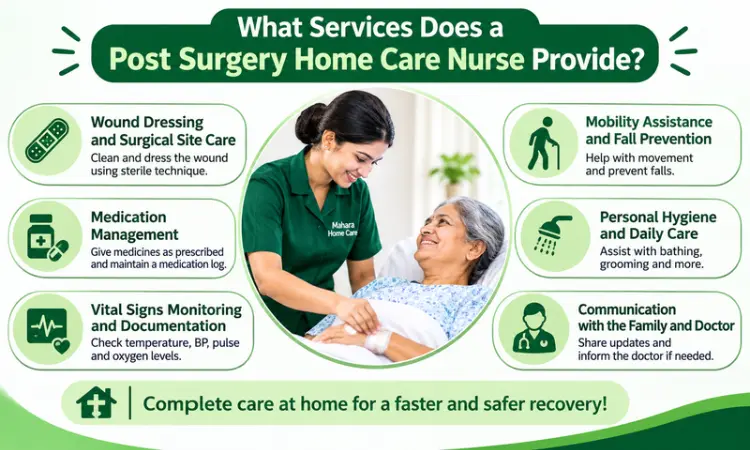
Post operative care at home covers clinical and non-clinical tasks, all directed by the surgeon’s written protocol. Here is what a trained nurse typically handles.
1. Wound dressing and surgical site care
The nurse cleans the incision using sterile technique, applies fresh dressings at the intervals the surgeon sets, and inspects the wound each time for redness, swelling, warmth, discharge or separation. Any change is documented and reported to the surgeon the same day. Family members should not attempt surgical dressing changes without training; contamination turns a healing wound into an infected one.
2. Medication management
Medicines are given exactly as prescribed: oral tablets, topical applications and, where the surgeon has ordered them, injections. A written medication log tracks every dose, the time it was given, and any side effect. This log goes with the patient to follow-up appointments. If a medicine causes nausea, dizziness or a reaction, the nurse informs the doctor before skipping or changing anything. Mahara’s post-surgery service page says a medication log is maintained and shared with the surgeon at follow-ups.
3. Vital signs monitoring and documentation
Temperature, blood pressure, pulse and oxygen saturation are checked at intervals the surgeon sets, typically twice a day in the first week. A rising temperature or a drop in oxygen is an early warning. Daily notes summarise the patient’s condition, food intake, fluid intake and any complaint, creating a record the doctor can review without relying on the family’s memory.
4. Mobility assistance and fall prevention
After abdominal, orthopaedic or spinal surgery, the patient needs help standing, walking to the bathroom and shifting in bed. Incorrect movement can strain the incision or dislocate a joint replacement. The nurse follows the surgeon’s and physiotherapist’s instructions on how much movement is allowed and when. Bed-ridden patients need position changes every two hours to prevent pressure injuries.
5. Personal hygiene and daily care
Bathing, oral care, grooming and changing clothes are difficult when the patient cannot bend, lift arms or stand long. The nurse handles these tasks without disturbing the surgical site, and monitors skin condition for rashes, pressure marks or irritation from bandages or catheters.
6. Communication with the family and doctor
The nurse updates the family on the patient’s progress each day and contacts the surgeon if warning signs appear: fever, increasing pain, wound changes, swelling in a limb, breathing difficulty or confusion. This bridge between hospital and home keeps the surgeon informed without the family having to interpret medical signs on their own.
How Home Nursing Reduces Post-Surgery Recovery Challenges
Families face four common challenges after a surgical discharge. Post surgery nursing care addresses each one directly.
| Challenge | Without a nurse | With a home care nurse |
| Wound infection risk | Family attempts dressing with kitchen-clean hands; delayed recognition of redness or discharge | Sterile technique, daily wound inspection, same-day reporting to the surgeon |
| Missed or wrong medicines | Doses forgotten during night shifts or mixed up between family members | Written log, fixed schedule, nurse administers every dose |
| Mobility and fall risk | Patient tries to stand alone; family lifts incorrectly | Nurse follows physiotherapist’s movement plan; position changes on schedule |
| Family exhaustion | One person handles feeding, cleaning, medicines and work | Nurse takes clinical and personal care tasks; family focuses on emotional support and meals |
Pain management is a particular gap. The patient often waits until pain is severe before mentioning it, and the family does not have a scale to measure whether the pain pattern is expected or a sign of complication. A nurse tracks pain at each vital-sign check and reports trends. For patients needing physiotherapy alongside nursing, coordinated scheduling keeps the two from conflicting.
Hygiene is the second gap. After abdominal or orthopaedic surgery, the patient cannot bend, lift arms or stand for long. Bathing, oral care and changing clothes become tasks that need another person, and doing them without disturbing the surgical site requires someone who has done it before. A caretaker or nurse handles these tasks and monitors the skin for pressure marks, rashes or catheter irritation.
Which Patients Need a Post-Surgery Nurse at Home?
Not every surgery needs professional home care. A young, otherwise healthy person after a minor procedure may manage with family support alone. The following situations typically call for a nurse.
• Patients discharged after major surgery: knee or hip replacement, cardiac procedures, abdominal or spinal surgery, or any procedure requiring wound dressing changes and drain management
• Elderly patients with slower healing, other conditions such as diabetes or hypertension, or reduced mobility before the surgery
• Patients who live alone or whose family members work during the day and cannot provide continuous care
• Patients on multiple medicines whose timing and interactions are difficult for the family to manage
• Patients discharged with catheters, surgical drains or pressure-injury risk who need procedures a family member should not attempt without training. For bedridden patients in Mysore, the requirement is stronger
The level of care depends on the surgery, the patient’s overall health and the surgeon’s recommendations. Ask the surgeon before discharge whether home nursing is needed and, if so, what level: a trained nurse for clinical tasks, a caretaker for daily living assistance, or both.
| Surgery type | Why home nursing often helps |
| Knee or hip replacement | Joint precautions, positioning rules, physiotherapy coordination, fall risk during early mobility |
| Abdominal surgery | Wound dressing on a large incision, drain management, dietary transition from liquids to solids |
| Cardiac surgery | Activity limits, multiple medicines on strict schedules, monitoring for fluid retention or breathing changes |
| C-section and gynaecological | Incision care while the mother manages a newborn, breastfeeding support, limited lifting |
| Spinal and neurosurgical | Log-rolling for position changes, sensory checks, catheter management, pressure injury prevention |
Mahara Home Care’s Mangalore service page lists these surgery types among those it supports. For Mysore patients, confirm coverage when you call.
What to Check Before Hiring a Post-Surgery Home Care Nurse in Mysore
Choosing the wrong caregiver is worse than choosing none, because a false sense of security leads to missed signs. Our earlier guide on how to choose home care in Mysore covers general points; here are the ones that matter specifically for post-surgery care.
Does the nurse have relevant experience?
Ask about experience with your surgery type. Post-orthopaedic care, for example, involves joint-replacement precautions, positioning rules and physiotherapy coordination that differ from abdominal post-op care. Ask the agency how it matches a caregiver to the patient.
What verification has the agency done?
At a minimum, expect government-issued ID verification, reference checks and an in-person assessment. Mahara Home Care’s site says every caregiver completes these steps. Ask to see the ID and the assessment record yourself.
Is the service available for the hours you need?
Shifts vary: an 8-hour day shift, a 12-hour night shift, 24-hour care with rotation, or short-term recovery support for a few days to a few weeks. Confirm which option the agency offers and whether the shift covers the hours when your family member is alone. Night shifts matter when the patient needs help turning or using the bathroom.
How are costs confirmed?
Get the rate in writing before the first shift. Ask whether consumables (dressings, gloves, thermometer) are included or billed separately, and whether the rate changes for public holidays or extended hours.
How do family members support the recovery?
Family handles what a nurse does not: emotional support, home-cooked meals following the surgeon’s diet, encouragement to move as prescribed, tracking follow-up dates, and communicating with relatives. Keep a shared notebook or phone group where the nurse logs updates and the family adds questions for the next doctor visit.
One practical point: agree with the nurse on what gets reported immediately versus what waits for the daily summary. Fever, wound changes, sudden pain or confusion should reach the family and surgeon within minutes. A missed dose or a change in appetite can wait for the evening update.
Post Surgery Home Care Costs in Mysore
Mahara Home Care’s Mysore page lists indicative rates. The final rate depends on caregiver experience, care complexity and the surgery type, and is confirmed in writing before the first shift.
| Care plan | Indicative rate (Mysore) |
| Daily living assistance, 3 hours | ₹600 to ₹750 |
| Daytime nursing care, 8 hours | ₹1,500 to ₹1,800 per day |
| Night duty, 12 hours | ₹1,800 to ₹2,200 per night |
| 24-hour care, two caregivers in rotation | ₹4,000 to ₹5,500 per day |
| Post-hospital visit (single) | ₹800 to ₹1,200 per visit |
The Mangalore-focused post-surgery service page also lists surgery-specific packages: a first-week package at ₹8,000 to ₹12,000, a two-week recovery package at ₹14,000 to ₹22,000 and monthly post-surgical care at ₹25,000 to ₹42,000. Ask whether these packages apply in Mysore, because the site does not say so explicitly.
When comparing post surgery care at home in Mysore, ask at least two providers for a written quote against the same brief: surgery type, hours needed, duration and whether consumables are included. Rates alone do not tell you about caregiver quality, so treat price as one factor, not the only one.
Why Choose Mahara Home Care for Post-Surgery Nursing Services in Mysore?
Mahara Home Care operates from Door No. 5906/1, Benaka, General Thimmaiah Road, opposite Vishal Mart, Vijayanagar, Mysuru 570017. The Mysore phone number is +91 8050030666 and the email is info@maharahomecare.com. The company was established in 2025 by Vijesh Kumar and Manjunath HC, who report 7+ years of prior experience in home healthcare operations across coastal Karnataka.
Its home nursing services in Mysore page lists post-surgery care among nine service categories, alongside elder care, palliative care, physiotherapy, post-natal care, intensive care, patient care, caretaker services and nanny care. It names Vijayanagar, Kuvempunagar, Gokulam, Saraswathipuram, Hebbal, Nazarbad, Bogadi, Dattagalli, Srirampura and 15 other Mysore localities in its coverage area; for addresses on the city’s outer edge, availability is confirmed before booking.
The site says caregivers undergo government-issued ID verification, reference checks and an in-person assessment before their first shift. It does not state specific nursing qualifications (ANM, GNM or BSc Nursing) or registration numbers. Ask Mahara to confirm the caregiver’s nursing qualification and registration for your case, especially where the surgeon prescribes clinical tasks such as injections or catheter care.
For patients who need post-surgery support alongside elder care or long-term patient care, ask the team about combined care plans. Book through the appointment page or call the Mysore number above.
Need Post-Surgery Home Care in Mysore?
If your family member is being discharged after surgery and you are not confident about handling wound care, medicines and mobility at home, professional help narrows the risk. Share the surgery details, the discharge date and the care hours you need.
Book Post Surgery Care in Mysore or call +91 8050030666 to discuss your requirements.
General information only: it does not replace your surgeon’s or doctor’s advice.
Frequently Asked Questions
How soon after surgery can a home care nurse start in Mysore?
Mahara Home Care’s Mysore page says care can begin on the day of discharge. Share the patient’s details, the surgery type and the discharge date, and the team matches a caregiver. Confirm timing when you call, because availability depends on the care level and the area.
Does the home care nurse follow the surgeon’s discharge instructions?
Yes. The nurse works from the surgeon’s written protocol for wound care, medicines and activity limits. A medication log and daily notes are kept and shared with the doctor at follow-up visits. The nurse does not change the treatment plan.
Can a home nurse handle wound dressing after orthopaedic surgery?
Wound dressing is part of post-operative care at home. The nurse cleans the surgical site using sterile technique and applies dressings as the surgeon instructs. Report any sign of infection, such as increasing redness, swelling, warmth or discharge, to the surgeon the same day.
What does post surgery home care cost in Mysore?
Mahara Home Care’s Mysore page lists indicative daily rates from ₹600 for a 3-hour daily living session to ₹4,000 to ₹5,500 for 24-hour care with two caregivers. The final rate depends on the surgery type, care level and caregiver experience, and is confirmed before the first shift.
How do family members and the nurse share responsibilities?
Family handles emotional support, meals, diet compliance and follow-up appointment logistics. The nurse handles wound care, medicines, vitals, hygiene and mobility as the surgeon prescribes. Both watch for warning signs and communicate changes to each other and the doctor.
About the Author
• Vijesh Kumar is a co-founder of Mahara Home Care with experience in home healthcare and patient support services. He focuses on providing reliable care solutions for elderly people, patients and families across Udupi, Manipal, Mangalore, Mysore and nearby areas.
• Reviewed by L K Monu Borkala, a digital marketing strategist with 20+ years of experience producing informational content across healthcare services, home care and professional services verticals. He is not a licensed clinician; this review covers content accuracy, tone and compliance with editorial standards, not clinical guidance.