This article is for informational purposes only and does not replace medical advice. Home nursing and caretaker support should always follow the patient’s doctor-prescribed care plan; a patient with complex or changing medical needs should be assessed by their treating healthcare professional.
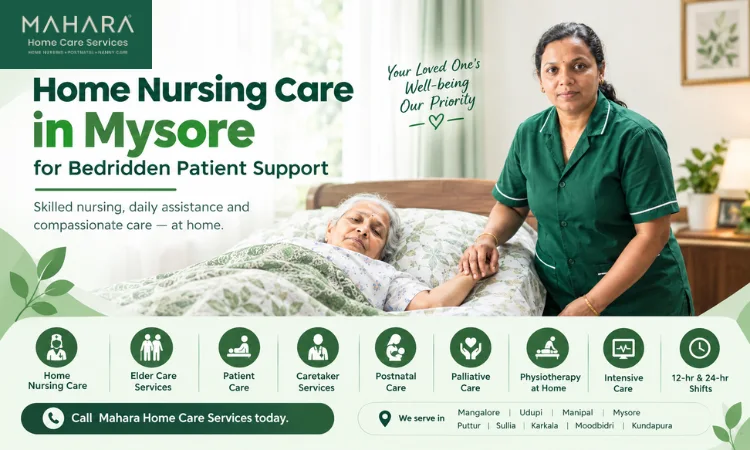
Home nursing care in Mysore for a bedridden patient combines trained nursing support with daily-living assistance: personal hygiene, feeding, positioning, medication routines, vital monitoring, and clinical procedures handled only by qualified staff. The right level of support depends on the patient’s specific condition, and complex or changing medical needs should always be assessed by the treating doctor. When a family member can no longer get out of bed on their own, whether after a stroke, a major surgery, or a long illness, daily routines that once took minutes start taking hours. Bathing, feeding, changing positions and watching for small changes in condition become constant work, often falling entirely on one or two relatives. Home nursing care in Mysore exists for exactly this situation: trained support brought into the patient’s own home, built around what that specific patient actually needs rather than a fixed routine applied to everyone.
What follows covers what that support actually involves: daily hygiene and feeding, positioning and mobility help, medication routines, and the clinical tasks that need a trained nurse rather than a caretaker. It also covers when home nursing makes sense, how to choose a home nurse in Mysore, safety at home, and roughly what the service costs. The focus stays specifically on bedridden patient support rather than repeating everything already covered on Mahara’s home nursing services in Mysore page.
What Is Home Nursing Care for a Bedridden Patient?
Home nursing care for a bedridden patient means professional support delivered at home rather than in a hospital or care facility, covering both clinical nursing tasks and non-clinical daily assistance. It differs from family caregiving mainly in training: a professional follows the treating doctor’s care plan and is more likely to notice a warning sign a family member might miss. Three broad levels of support exist, each with a different scope:
| Role | Training | Typical Tasks | Clinical Procedures |
| Home Nurse | Formal nursing qualification | Vital monitoring, wound care, medication administration, catheter and tube care | Yes, within training and the doctor’s plan |
| Nursing Attendant | Basic caregiving training, works under nursing supervision | Hygiene, feeding, positioning, mobility support, basic monitoring | Limited, only as directed and supervised |
| General Caretaker | Non-clinical caregiving experience | Hygiene, feeding, companionship, daily routine support | No |
Bedridden patients can have very different levels of dependency. Some need daily supervision and non-clinical help; others need ongoing nursing care such as wound dressing or tube feeding. Basic nursing support, vital sign monitoring, wound checks, medication, and clinical procedures such as injections or catheter care, should only be performed by appropriately qualified personnel, following the treating doctor’s instructions exactly.
What does a home nurse do for a bedridden patient? A home nurse monitors vital signs, manages wound care and catheter or feeding-tube support where clinically required, assists with positioning to reduce the risks of prolonged bed rest, and administers medication as prescribed. Non-clinical tasks such as hygiene, feeding assistance and companionship are typically handled by a caretaker or nursing attendant working alongside the nurse.
Why Do Bedridden Patients Need Regular Care at Home?
Patients confined to bed face daily challenges that aren’t always obvious from outside. Moving becomes difficult or impossible without help, so bathing, dressing, toileting and eating often need another person’s hands. Changing clothes and bedsheets without causing discomfort takes technique, not just willingness. Positioning has to be managed regularly, since staying in one posture for long stretches carries its own risks, and someone has to notice small changes, appetite, alertness, skin condition, before they become bigger problems. NIH’s overview of pressure ulcer risk covers why regular repositioning and skin checks matter for anyone spending extended time in bed.
Beyond the physical tasks, there’s an emotional side too. Prolonged bed rest can be isolating, and family caregivers often carry this on top of jobs and their own health, day after day, without much of a break.
What Does Home Nursing Care in Mysore Include?
Exactly which services a patient needs depends on their condition and care plan. This is part of the broader home care services Mysore families rely on, and for a bedridden patient it typically covers five areas:
Personal Hygiene and Daily Care
Bathing assistance, oral hygiene, grooming, changing clothes and bedsheets, and toileting assistance, handled with attention to the patient’s dignity and privacy.
Feeding and Nutrition Support
Help during meals for patients who can’t feed themselves, support for the prescribed dietary routine, and attention to adequate hydration. Any special feeding requirement, including tube feeding, follows professional instructions exactly.
Positioning and Mobility Assistance
Safe position changes at regular intervals, support for whatever basic movement the patient can manage, transfer assistance where needed, and following physiotherapy recommendations when they’re part of the care plan.
Medication and Routine Support
Medication reminders and support following the prescribed schedule exactly, keeping a record of relevant care information, and telling family members promptly about anything unusual.
Basic Nursing Support
Where clinically appropriate, this can include vital sign monitoring, wound dressing, catheter care, Ryle’s tube care, injections and other prescribed nursing procedures, always performed by appropriately qualified staff and never by a general caretaker. Mahara’s Mysore service follows this same principle: clinical procedures are supported only when appropriately qualified staff are available.
How Can Home Nursing Help Families Caring for Bedridden Patients?
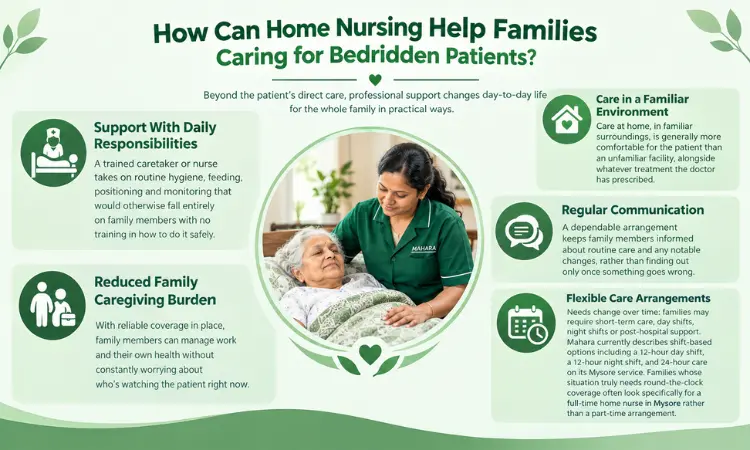
Beyond the patient’s direct care, professional support changes day-to-day life for the whole family in practical ways.
Support With Daily Responsibilities
A trained caretaker or nurse takes on routine hygiene, feeding, positioning and monitoring that would otherwise fall entirely on family members with no training in how to do it safely.
Reduced Family Caregiving Burden
With reliable coverage in place, family members can manage work and their own health without constantly worrying about who’s watching the patient right now.
Care in a Familiar Environment
Care at home, in familiar surroundings, is generally more comfortable for the patient than an unfamiliar facility, alongside whatever treatment the doctor has prescribed.
Regular Communication
A dependable arrangement keeps family members informed about routine care and any notable changes, rather than finding out only once something goes wrong.
Flexible Care Arrangements
Needs change over time: families may require short-term care, day shifts, night shifts or post-hospital support. Mahara currently describes shift-based options including a 12-hour day shift, a 12-hour night shift, and 24-hour care on its Mysore service. Families whose situation truly needs round-the-clock coverage often look specifically for a full-time home nurse in Mysore rather than a part-time arrangement.
When Should You Consider Home Nursing Care for a Bedridden Patient?
Families often start looking into home nursing after a hospital discharge, during recovery from surgery, or once mobility limitations become long-term rather than temporary. It also comes up for elderly patients needing daily assistance, patients recovering from a stroke, anyone requiring wound or catheter care, and situations where family members simply can’t provide continuous care alongside their own jobs and responsibilities.
Not every bedridden patient needs the same level of support, and home nursing isn’t automatically the right fit for every situation. A patient with complex or changing medical needs should be assessed by their treating healthcare professional first, so the type and level of home support actually matches what the patient’s condition requires.
How to Choose the Right Home Nurse in Mysore
Check Qualifications
Ask about the caregiver’s nursing qualification and experience, and match their specific skills to the patient’s actual needs. A qualified nurse’s registration can generally be checked against the Indian Nursing Council, which maintains the national framework for nursing registration in India.
Explain the Patient’s Condition
Before a caregiver is assigned, share the patient’s age, medical condition, mobility level, feeding requirements, medication routine, and any wound or catheter needs, along with the required shift duration. Some families specifically request a male nurse for home care in Mysore for comfort or physical support during transfers; this is worth raising directly with the provider.
Ask About Verification
Confirm whether the provider carries out identity verification, reference checks and background verification before assigning staff. Mahara states on its website that caregivers go through government ID verification, reference checks and an in-person assessment before their first shift.
Confirm the Scope of Care
Families should understand exactly what a caretaker will handle and what requires a qualified nurse or doctor, in writing where possible, so there’s no confusion once care begins.
Ask About Replacement Support
Find out what happens if the assigned caregiver becomes unavailable. Continuity of care matters for a bedridden patient, and a provider should have a clear answer ready.
Discuss Shift Requirements
Cover day, night, 12-hour and 24-hour options against the patient’s actual needs, since requirements can shift as recovery progresses.
Safety Tips for Bedridden Patient Care at Home
- Keep the patient’s room clean, organised and free of clutter
- Keep frequently needed items within safe, easy reach
- Maintain clean bedding and personal-care items
- Follow prescribed medication instructions exactly, without adjusting timing or dose independently
- Use safe techniques when repositioning or transferring the patient, ideally shown by a trained professional
- Follow physiotherapy or mobility guidance from the treating professional rather than improvising
- Watch for changes in the patient’s condition, appetite, alertness, skin, breathing, and note them
- Keep emergency contact numbers, including the treating doctor’s, somewhere accessible
- Never ask an untrained person to carry out a clinical procedure
- Seek urgent medical attention for warning signs such as sudden breathing difficulty, unresponsiveness, high fever, uncontrolled bleeding, or a wound that looks infected or is rapidly worsening
How can families make home care safer for a bedridden patient? Families can make home care safer by keeping the room organised, following medication and repositioning instructions exactly as prescribed, watching for changes in condition, keeping emergency numbers accessible, and never letting an untrained person attempt a clinical procedure meant for a qualified nurse.
How Much Does Home Nursing Care Cost in Mysore?
There’s no single price that applies to every bedridden patient; cost depends on several factors specific to the situation:
| Factor | How It Affects Cost |
| Type of care needed | Nursing care generally costs more than non-clinical caretaker support, given the training involved |
| Number of hours | More hours of coverage per day naturally increases the daily or monthly cost |
| Day or night shift | Night shifts can be priced differently from day shifts depending on the provider |
| 24-hour requirement | Round-the-clock coverage with shift rotation costs more than a single fixed shift |
| Clinical complexity | Wound care, catheter care or tube feeding typically cost more than basic daily assistance |
| Duration of care | Short-term, post-hospital support is often priced differently from long-term ongoing care |
The most reliable way to plan is to request a clear, written quotation based on the patient’s actual condition and requirements, rather than relying on a general figure. Treat any “cheapest” or “lowest price guaranteed” claim with caution, since a genuine quote depends on the specific case.
Home Nursing Care for Different Patient Needs in Mysore
Care requirements look different depending on the situation:
- Bedridden elderly patients often need daily supervision alongside hygiene and mobility support
- Post-surgery patients typically need more intensive support in the first weeks, tapering off as recovery progresses
- Stroke recovery patients may need a combination of nursing care and physiotherapy-linked mobility support
- Patients with limited mobility need consistent positioning and transfer assistance
- Patients needing wound care require a qualified nurse rather than a general caretaker
- Patients requiring catheter support need the same qualified nurse involvement
- Patients requiring long-term assistance benefit from a stable, consistent caregiver relationship over time
The key point across all of these is that care should be matched to the patient’s actual condition, not applied as a single fixed plan for everyone.
Conclusion
Appropriate support for a bedridden patient isn’t one-size-fits-all; it depends on the person’s specific condition, mobility level and medical needs. Professional home care can help with daily routines, hygiene, feeding, positioning, monitoring and comfort, alongside the nursing requirements a doctor has actually prescribed. Families choosing between a caretaker at home in Mysore and a nurse should base that decision on qualifications and what the patient actually requires, not on cost alone. For anything involving complex or changing medical needs, the treating doctor’s assessment should guide the decision. For families in Mysore weighing up home nursing care in Mysore for a bedridden family member, matching the right kind of support, and the right person, to the patient’s actual condition makes the biggest difference to how well that care works day to day.
| Talk to Mahara Home Care’s Mysore Team Considering home nursing care in Mysore for a bedridden family member? Mahara Home Care’s Mysore office can help match the right level of support, caretaker or nurse, to the patient’s specific condition. Call +91 80500 30666, email info@maharahomecare.com, or get in touch through the Mysore contact page to discuss the situation. |
Frequently Asked Questions
1. What is the difference between a home nurse and a caretaker for a bedridden patient?
A home nurse is trained to carry out clinical tasks such as wound care, catheter care and medication administration under a doctor’s direction, while a caretaker provides non-clinical daily support such as hygiene, feeding and positioning. Many bedridden patients need a combination of both, depending on their condition.
2. How much does home nursing care in Mysore cost for a bedridden patient?
Cost depends on the type of care needed, the number of hours, whether it is a day, night or 24-hour shift, and how clinically complex the case is. A written quote based on the patient’s actual condition is more reliable than a general estimate.
3. Can a caretaker perform wound care or give injections?
No. Wound care, injections, catheter care and similar clinical procedures should only be performed by appropriately qualified nursing staff, following the treating doctor’s instructions, not by a general caretaker.
4. How do I know what kind of care my bedridden family member actually needs?
Start by sharing the patient’s condition, mobility level, feeding requirements, medication routine and any wound or catheter needs with the provider, so the right combination of nursing and caretaker support can be matched to the actual situation rather than assumed.
5. Does Mahara Home Care provide 24-hour home nursing care in Mysore?
Yes. Mahara Home Care’s Mysore service currently includes 12-hour day, 12-hour night and 24-hour care options for bedridden and other patients, with the right shift depending on the patient’s specific needs.
About the Author
Vijesh Kumar is a co-founder of Mahara Home Care with experience in home healthcare and patient support services. He focuses on providing reliable, compassionate care solutions for elderly people, patients, and families across Udupi, Manipal, Mangalore, Mysore and nearby areas.
Reviewed By
L K Monu Borkala is a digital marketing strategist with 20+ years of experience producing informational content across healthcare services, home care, and professional services verticals. He is not a licensed clinician; this review covers content accuracy, tone and compliance with editorial standards, not clinical guidance.