
My mother-in-law fell in the bathroom last monsoon. She’d been managing on her own in Mangalore while we were in Bangalore – until she wasn’t. That’s how most families discover home health services for seniors. Not through planning, but through a crisis.
It doesn’t have to be that way. Whether it’s a parent recovering from hip surgery, a father whose diabetes needs daily monitoring, or a grandmother who’s simply not safe alone anymore – there’s a middle ground between “they’ll manage” and moving them to an institution.
Home health services bring trained medical and personal care support directly to your parent’s home. A skilled nurse for post-surgery recovery. A daily caregiver for elderly parents who need help with bathing, meals, and mobility. Specialized support for dementia or palliative care. All in the environment they’re most comfortable in.
This guide covers what these services actually include, what they cost in Mangalore specifically, how to pick a provider you can trust, and when it’s time to stop waiting and get help.
What Are Home Health Services for Seniors?
Think of home health services as bringing the hospital’s care to your parent’s bedroom – minus the hospital. A trained professional shows up at your door and provides whatever level of support your senior needs, from clinical nursing to simple daily help.
There are two broad buckets here.
Medical care is the clinical side. A qualified nurse handles wound dressing, IV lines, injections, BP and sugar monitoring, catheter care, and oxygen management. If your parent’s on five different prescriptions – which isn’t unusual past 70 – a nurse makes sure every dose is right, on time, and doesn’t conflict with anything else they’re taking.
Non-medical care is the daily life side. Bathing, grooming, getting dressed, using the washroom, eating, moving around the house safely. A home attendant doesn’t do clinical work, but for a senior who’s unsteady on their feet or recovering from a fracture, this support is what keeps them safe between doctor visits.
Who actually needs this? Seniors coming home after surgery. People managing chronic conditions – diabetes, heart disease, COPD. Elderly parents with limited mobility or early-stage dementia. And honestly? Even relatively healthy 75-year-olds who just can’t manage the stairs or the kitchen like they used to.
Types of Home Health Services Available
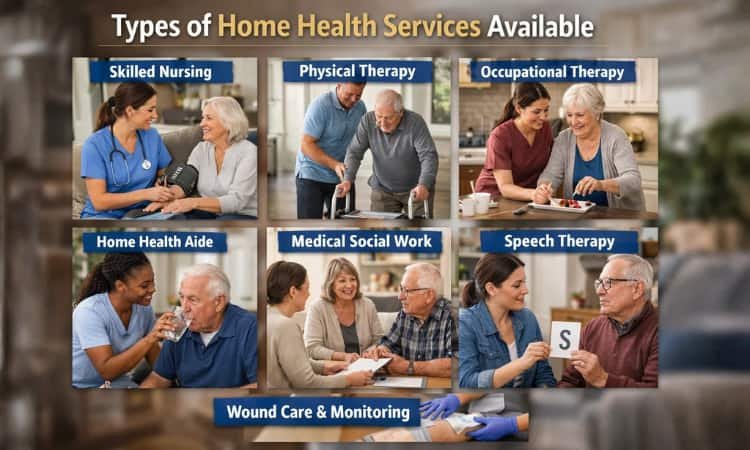
Not every senior needs the same level of care. Some need clinical supervision, others just need someone to help them through the day, and some need specialized attention for specific conditions. Here’s how it breaks down.
Medical Care Services
This is the clinical side – delivered by qualified nurses and healthcare professionals.
Skilled nursing is what most families look for first. A trained nurse comes home and handles wound dressing, IV administration, injections, BP monitoring, blood sugar tracking, catheter care, and oxygen support. If your parent’s dealing with diabetes, heart disease, or respiratory issues, regular nursing visits at home cut down those exhausting hospital trips dramatically.
Post-surgery care is where home nursing really proves its value. After a hip replacement, cardiac procedure, or cataract surgery – your parent doesn’t need a hospital bed. They need someone checking vitals, cleaning wounds, giving medications on time, and catching complications early. That’s exactly what a home nurse does, at a fraction of hospital costs.
Medication management is the one families underestimate most. When your parent’s on six different prescriptions – and half of them interact with each other – getting the dosages, timings, and combinations right isn’t something you can leave to a handwritten chart on the fridge. A trained caregiver handles this systematically, and it directly impacts health outcomes.
Non-Medical Care Services
This is the day-to-day support that keeps your parent’s routine running. No clinical procedures involved, but the impact on quality of life? Equally significant.
Personal hygiene – bathing, grooming, oral care, dressing, toileting. For seniors dealing with arthritis, post-stroke weakness, or general frailty, these tasks that seem basic become genuinely difficult. Finding a reliable home attendant for elderly near me who handles this with patience and dignity – that’s what changes the daily experience for your parent.
Mobility support is really about fall prevention. A caregiver helps with moving around the house, getting in and out of bed, using the washroom, walking safely. Falls are among the leading causes of serious injury in older adults – a broken hip at 78 can change everything. Having someone physically present reduces that risk significantly.
Meal preparation matters more than most people realize. A lot of seniors living alone skip meals, eat whatever’s easiest, or can’t cook safely anymore. A caregiver ensures timely, balanced meals suited to their dietary needs – whether it’s a diabetic diet, low-sodium food, or just making sure they’re eating three proper meals a day.
Specialized Care
Some conditions need caregivers with specific training that goes beyond general nursing.
Dementia and Alzheimer’s care is probably the most sensitive area. Patients with memory conditions need someone who understands the behavioural patterns – the confusion, the agitation, the wandering. Someone who can keep them safe without making them feel locked down. This requires specific training and a temperament that not every caregiver has.
Palliative care focuses on comfort, not cure. For seniors dealing with serious or terminal illnesses, the goal is managing pain, reducing discomfort, and giving emotional support to both the patient and the family. Having this care at home – rather than in a hospital ward – lets the senior spend their time in peace, surrounded by people they love.
Physiotherapy at home is becoming very common, especially for seniors recovering from fractures, joint replacements, or strokes. A physiotherapist visits regularly, guides exercises, works on range of motion, and helps rebuild strength. No exhausting trips to a clinic. No waiting rooms. Just consistent, supervised recovery in familiar surroundings.
Benefits of Home Health Care for Seniors

Let’s be direct about why home care works better for most seniors.
Your parent recovers faster at home. This isn’t just a feel-good statement – there’s solid medical backing. Fewer hospital-acquired infections, less stress, consistent sleep in their own bed, meals they actually want to eat. Doctors will tell you that a patient who’s comfortable and calm heals noticeably quicker than one who’s anxious in a hospital ward.
They get undivided attention. In a hospital, one nurse is juggling 8-10 patients per shift. At home, your caregiver is focused on one person – your parent. That means medications on time, discomfort addressed immediately, and care that adapts to your parent’s specific routine. Not the hospital’s schedule.
It costs significantly less than you’d think. A full-time home attendant in Mangalore runs Rs 12,000-25,000 per month. Compare that to even a week of hospitalization at KMC or Father Muller – room rent, nursing charges, consumables, doctor visits – and the math is obvious. For families managing chronic conditions over months or years, this difference adds up to lakhs.
And then there’s the part nobody talks about enough – emotional well-being. Seniors who stay home don’t feel institutionalized. They’re still part of the family’s daily life. They see the neighbours, hear the temple bells, eat food that tastes like home. A trained caregiver for elderly parents doesn’t just provide physical support – they become a daily companion. For a lot of seniors, especially those whose children live in other cities, that companionship matters as much as the medical care.
When Do Seniors Need a Caregiver at Home?
Most families don’t plan for this. They react to it. A fall. A hospital admission. A phone call from a neighbour saying “your father hasn’t opened the door in two days.” By then, you’re making decisions under pressure – and that’s never ideal.
Here’s what to watch for before things reach that point.
They’re struggling with daily basics. If your parent can’t bathe independently, is skipping meals because cooking’s become too hard, or needs help getting out of bed – that’s not aging gracefully. That’s a safety risk. A professional home attendant for elderly near me can step in and handle these tasks properly, reducing the chance of falls and injuries during routine activities.
Hospital visits are becoming a pattern. If your parent’s being admitted every few weeks for the same issue – blood sugar crashes, breathing difficulty, fall-related injuries – it usually means their daily health management at home isn’t working. A trained in-home caregiver can monitor vitals daily, manage medications, and catch warning signs before they become emergencies. That’s preventive care, and it works.
Memory is slipping. Forgetting medications. Leaving the gas on. Getting confused inside their own house. Repeating the same conversation three times in an hour. These aren’t just “senior moments” – they’re early signs of cognitive decline that need professional attention. A caregiver trained in dementia support provides structure, safety, and gentle guidance throughout the day.
They’re withdrawing emotionally. If a parent who was once active and social is now staying in bed all day, refusing meals, avoiding conversation – don’t dismiss it as “just old age.” Loneliness and depression are real and common in elderly people living alone. A dedicated caregiver brings daily human interaction, conversation, and companionship that can genuinely lift their spirits.
If you’re already wondering whether your parent needs help – they probably do. Don’t wait for the emergency. That’s the one thing every family I’ve spoken to wishes they’d done differently.
Cost of Home Health Services for Seniors in Mangalore
A part-time caregiver who comes in for 4-6 hours daily – helping with bathing, meals, mobility, companionship – runs about Rs 200-500 per hour. Most families on this plan spend Rs 8,000-15,000 per month.
Full-time home attendants on 12-hour or 24-hour shifts cost Rs 12,000-25,000 monthly. This covers personal hygiene, feeding, mobility support, and someone being physically present so your parent isn’t alone.
Skilled nursing – a qualified nurse handling post-surgery care, wound dressing, catheter management, IV lines – runs Rs 18,000-40,000 per month depending on the medical complexity.
For context: a single week at KMC Hospital or Father Muller – with room rent, nursing, and consumables – can easily cross Rs 40,000-60,000. A month of full-time home nursing costs less than that one week. That’s the comparison most families don’t make until it’s too late.
What moves the price? Three things. Type of care (nursing costs more than non-medical help). Duration (24-hour is pricier than 12-hour, obviously). And location within Mangalore – a caregiver travelling from Kankanady to Kadri is a quick commute, but Moodabidri or Bantwal assignments may carry a travel premium.
For a clear, no-surprises quote, talk to a local provider like Mahara Home Care directly. They’ll do a home assessment, understand your parent’s specific needs, and give you transparent pricing. No guesswork.
How to Choose the Best Home Health Care Provider
This is someone who’ll be in your parent’s home every day. With your vulnerable family member. The decision deserves more than a quick Google search. Here’s what to actually look for.
Check qualifications and training. Non-negotiable. If your parent needs medical care, the nurse must have valid certifications and clinical experience with seniors. For non-medical caregivers, ask what training they’ve completed – mobility handling, personal hygiene, fall prevention, emergency response. Don’t accept “we train them internally” without specifics.
Verify background checks. You’re letting a stranger into your home and trusting them with your parent’s safety. Any reliable provider will have done thorough verification – identity proof, address confirmation, police clearance, and references from previous families. If they hesitate when you ask about this? That tells you everything.
Look for genuine reviews. Not testimonials on their own website – those are curated. Check Google reviews. Ask the provider for references from families they currently serve. If possible, talk to those families directly. One honest conversation with a current client is worth more than any brochure.
Make sure they’re flexible. Care needs change. Your parent might need 4 hours of help today and 24-hour support six months from now. A good provider offers flexible plans – hourly, part-time, full-time, live-in – and lets you scale without restarting the process. This matters especially with progressive conditions like dementia.
Ask about their backup policy. Caregivers get sick. They take leave. Sometimes the chemistry with your parent just doesn’t work. What happens then? A dependable provider has a trained backup ready so your parent’s care isn’t interrupted. If they don’t have a backup system, you’ll find out the hard way.
Understand their emergency protocols. What happens if your parent has a medical emergency at 2 AM while the caregiver is on duty? Do they know first aid? Is there a coordinator on call? Do they have relationships with nearby hospitals? For families looking for home health services for seniors, these details are what separate a professional provider from someone who’s just filling a shift.
Request a trial period. Don’t commit long-term on day one. Ask for a 3-5 day trial. Watch how the caregiver interacts with your parent. See if your parent’s comfortable. Evaluate the quality of care firsthand. A provider who’s confident in their team won’t hesitate to offer this.
Why Localised Care Matters
Here’s a scenario that actually happens. Your father’s regular caregiver calls in sick at 7 AM. He needs help getting out of bed, using the washroom, and taking his morning medications. What happens next depends entirely on whether your care provider is local or remote.
A Mangalore-based provider like Mahara Home Care can have a trained backup at your door within 2-3 hours. An agency coordinating from Bangalore or Mumbai? You’re looking at a day or more – if they can arrange someone at all. In elder care, that gap isn’t an inconvenience. It’s a risk.
But speed is just one part of it. A local provider knows the Mangalore healthcare ecosystem from the inside. They know which pharmacies in Hampankatta deliver medications within the hour. Which diagnostic labs – like Anand Lab or Manipal Lab – do home sample collection. Which ambulance services actually respond fast. They’ve got relationships with the admission desks at KMC, Father Muller, and Yenepoya. When your parent needs urgent care at 11 PM, that network is worth more than any brochure.
Then there’s something families don’t always think about upfront – cultural fit. A caregiver from Mangalore speaks Tulu, Kannada, or Konkani. They know that your mother wants her filter coffee at 6:30 AM, not the tea that a generic agency’s care plan prescribes. They understand the food – neer dosa, fish curry, pathrade – not some standardized meal chart. For an 80-year-old who’s already anxious about having a stranger in the house, that cultural familiarity is what turns a caregiver into someone they actually trust.
Conclusion
If you’ve read this far, you’re probably not asking “does my parent need help?” anymore. You’re asking “how do I start?”
Here’s what I’d suggest. Call a local provider – not three, not five – just one good one. Describe your parent’s situation honestly. Ask them to do a home assessment. Most reputable agencies, including Mahara Home Care, do this for free. The assessor will spend 30-45 minutes with your parent, understand their medical history, daily routine, and mobility level, and then recommend a care plan with transparent pricing.
Before you sign anything: verify the agency’s background check process. Ask for references from families they currently serve in Mangalore. Check if they have a backup caregiver policy. And make sure the payment terms are clear – no hidden charges, no surprise escalations.
Your parent didn’t ask to need help. But they deserve help that’s competent, compassionate, and close to home. That’s what good home health services for seniors look like – not in a brochure, but in your parent’s living room, every single day.
Looking for trusted home health services for seniors in Mangalore?
Get in touch with Mahara Home Care today to find trained, verified caregivers near you and ensure the best care for your loved ones.
✔ Book a free consultation
✔ Request a background-verified caregiver
✔ Get a personalized home care assessment
Visit:maharahomecare.com
Call us today for a no-obligation discussion about your parent’s care needs.
Frequently Asked Questions
What is included in home health services for seniors?
Two categories. Medical care – skilled nursing, wound dressing, medication management, injections, post-surgery monitoring, catheter and IV support. Non-medical care – bathing, grooming, meal preparation, mobility help, and daily companionship. Some providers also offer specialized dementia care, palliative support, and home-based physiotherapy. The exact scope depends on your parent’s condition and what your family needs.
How much does a caregiver for elderly cost in India?
It varies by city and care type. In Mangalore specifically: non-medical home attendants run Rs 12,000-25,000 per month. Skilled nursing costs Rs 18,000-40,000 monthly. Hourly support is Rs 200-500 per hour. For comparison, a single week of hospitalization can cost Rs 40,000-60,000 – more than a full month of home nursing. Always get a customized quote based on your parent’s specific needs.
Are home health services better than hospitals?
For ongoing care, recovery, and daily support – yes, in most cases. Seniors heal faster at home, face fewer infection risks, and get one-on-one attention instead of sharing a nurse with ten other patients. That said, hospitals are still necessary for acute emergencies, complex surgeries, and intensive care situations. The smart approach? Use hospitals for what they’re built for, and home care for everything else.
How do I find elderly care at home near me?
Start local. Search for providers in your city, check their Google reviews (not just the testimonials on their website), and ask your family doctor or neighbours for recommendations. The non-negotiables: background-verified caregivers, flexible care plans, a clear backup policy, and a home assessment before they start. If they can’t offer all four, keep looking.
Do you provide elder care services in Mangalore?
Yes. Mahara Home Care provides comprehensive elder care services across Mangalore – trained home attendants, skilled nursing, dementia care, and physiotherapy at home. Every caregiver is locally based, background-verified, and trained specifically for senior care. Call us for a free home assessment and we’ll recommend a care plan that fits your parent’s needs and your family’s budget.