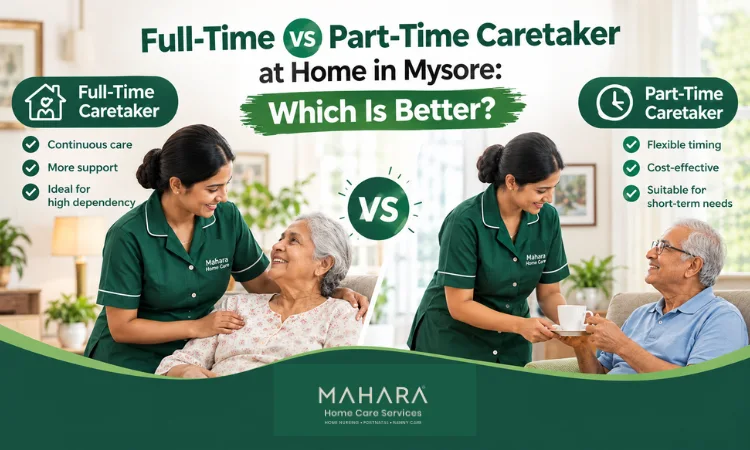
Neither a full-time nor a part-time caretaker at home in Mysore is universally better; the right choice depends on the person’s health condition, mobility, daily care needs, level of independence, need for supervision, and how much family members can realistically be present. Part-time care generally suits situations needing help during specific hours; full-time care suits patients needing continuous supervision or daily assistance throughout the day.
Deciding between a full-time and part-time caretaker at home in Mysore usually comes down to one honest question: how much daily supervision does this specific person actually need? There isn’t a single right answer that applies to every family; it depends on the person’s health condition, how mobile they are, what daily tasks they need help with, how independent they still are, how much supervision their situation calls for, and how much time family members can realistically give. A caretaker at home provides non-medical, day-to-day support, personal hygiene, mobility assistance, meals, companionship, medication reminders, for elderly people, patients recovering from surgery, bedridden individuals, and anyone needing regular daily assistance. Where a clinical need is also involved, a home nurse service in Mysore specifically covers that separate scope. Both full-time and part-time arrangements can work well, depending entirely on the situation they’re being used for. This guide compares the two directly: duties, benefits, working hours, costs, suitability, and the practical factors worth weighing before hiring either one. It’s worth being clear from the outset that medical procedures, wound care, injections, clinical monitoring, need a qualified healthcare professional; a caretaker’s role sits alongside that, not in place of it.
What Is a Caretaker at Home?
Among the range of home care services Mysore families can access, a caretaker at home provides non-medical daily support: personal hygiene, dressing and grooming, feeding assistance, mobility and transfer support, medication reminders, companionship and basic monitoring. It’s built around helping someone manage their day safely and comfortably, not around performing clinical procedures. This is distinct from elder care services in Mysore that specifically involve clinical oversight; for anything falling outside a caretaker’s non-clinical scope, wound dressing, injections and similar tasks, a trained nurse is the appropriate option instead.
What Is a Part-Time Caretaker?
A part-time caretaker provides support during specific, defined hours rather than around the clock, commonly a 12-hour day or night shift. This suits situations where help is needed during particular parts of the day, morning routines, meals, medication timing, evening supervision, rather than continuous presence.
Benefits of Part-Time Caretaker Services
- Lower cost than round-the-clock coverage
- Suits situations where family members can cover the remaining hours themselves
- Flexible scheduling around specific daily needs
- A practical option for shorter recovery periods or moderate assistance needs
What Is a Full-Time Caretaker?
A full-time caretaker provides continuous coverage, generally structured as 24-hour care with shift rotation between caretakers, so the person receiving care always has someone present. This suits situations needing constant supervision or assistance throughout both day and night.
Benefits of Full-Time Caretaker Services
- Continuous supervision for patients with higher dependency or fall risk
- No gaps in coverage between shifts or family availability
- Reduces the burden on family members who can’t be present all day
- Better suited to bedridden patients or those needing frequent assistance
Full-Time vs Part-Time Caretaker at Home in Mysore: Key Differences
| Factor | Part-Time Caretaker | Full-Time Caretaker |
| Working hours | Defined shift (e.g. 12-hour day or night) | Continuous, 24-hour with shift rotation |
| Best for | Specific daily needs, moderate assistance | Continuous supervision, higher dependency |
| Supervision | Limited to the shift period | Round-the-clock |
| Cost | Lower, based on hours booked | Higher, reflecting continuous coverage |
| Family involvement | Higher, covering remaining hours | Lower, caretaker covers most of the day |
| Flexibility | Easier to adjust hours as needed | Less flexible once a rotation is set |
| Elderly care | Suitable for moderate daily support | Suitable for higher-dependency or fall-risk cases |
| Patient support | Suitable for shorter recovery periods | Suitable for extended or intensive recovery needs |
Full-Time vs Part-Time Caretaker: Which One Is Better for Elderly Care?
For elderly people who are largely independent but need help with specific tasks, meals, medication reminders, occasional mobility support, part-time care during the hours it’s needed most is often enough. For elderly individuals with higher fall risk, confusion, or significant mobility limitations, full-time care provides the continuous supervision that reduces the chance of an unnoticed fall or a missed need going unaddressed. The honest answer depends on the specific person’s condition, not their age alone.
Which Option Is Better for Patients Recovering at Home?
Patients in the early days after surgery or a hospital discharge often need more intensive support initially, sometimes justifying full-time or 24-hour care for the first stretch, tapering to part-time as mobility and independence return. Recovery isn’t usually a fixed state; a patient’s care needs during the first week after discharge can look very different from their needs a month later, which is worth planning for rather than locking into a single arrangement for the entire recovery period.
Factors to Consider Before Hiring a Caretaker in Mysore
Care Recipient’s Condition
The specific health condition, mobility level and dependency degree of the person receiving care should drive this decision more than any other single factor.
Required Working Hours
Map out realistically which hours of the day actually need coverage, rather than assuming full-time is automatically safer.
Type of Assistance
Confirm whether the needs are purely non-clinical, personal care, mobility, companionship, or whether some clinical support is also required, which would call for a nurse alongside or instead of a caretaker.
Caregiver Experience
Check the caretaker’s experience with situations similar to your family member’s specific needs, not just general experience.
Reliability and Safety
Confirm background verification, identity checks, and what happens if the assigned caretaker is unavailable on a given day.
How Much Does a Caretaker at Home in Mysore Cost?
Costs vary according to the number of hours booked, the specific care requirements involved, the caretaker’s experience level, and whether the arrangement is part-time or full-time. A 12-hour part-time shift generally costs less than 24-hour full-time coverage, simply reflecting the difference in hours and continuity involved, but the exact figure depends on the individual situation rather than a single fixed rate. Getting a clear, written quote based on the actual care needs, rather than relying on a general estimate, is the more reliable way to plan.
How to Choose the Right Caretaker Service in Mysore
- Assess the person’s actual care requirements clearly before deciding between part-time and full-time
- Ask about caretaker background verification and experience relevant to the specific situation
- Confirm exactly what’s included in the service and what falls outside a caretaker’s non-clinical role
- Understand how the provider communicates with family and handles concerns
- Ask what happens if the assigned caretaker is unavailable, and how quickly a replacement is arranged
- Get pricing confirmed clearly in writing before the arrangement begins
Conclusion
Both full-time and part-time caretaker services can truly help, depending on what the situation actually calls for. Part-time care generally suits families needing assistance only during certain hours, while full-time care tends to be more suitable when regular supervision and daily assistance are required throughout the day. The decision should come down to the person’s health, mobility, safety, family availability and daily care needs, reviewed clearly rather than assumed once and left unchanged; care requirements can shift over time and are worth reassessing periodically. Whatever the situation, finding a reliable and dependable home nursing services in Mysore starts with an honest assessment of what’s actually needed, not a default choice made out of convenience.
Looking for a trusted caretaker in Mysore for a family member? Call the Mysore office at +91 8050030666, or get in touch with Mahara Home Care to discuss your situation.
Frequently Asked Questions
Is full-time or part-time caretaker care better for elderly parents?
Neither is universally better; it depends on the parent’s specific health condition, mobility and supervision needs. Part-time care suits moderate daily assistance, while full-time care suits situations needing continuous supervision, such as higher fall risk or significant mobility limitations.
Can a part-time caretaker be upgraded to full-time later?
Yes, care arrangements can generally be adjusted as needs change, moving from part-time to full-time or the reverse, depending on how the person’s condition and recovery progress over time.
What is the difference between a caretaker and a home nurse in Mysore?
A caretaker provides non-medical daily support such as hygiene, mobility assistance and companionship, while a home nurse is trained to carry out clinical tasks like wound care, medication administration and health monitoring under a doctor’s direction.
How do I decide how many hours of caretaker support I need?
Map out the specific daily tasks the person needs help with and which hours those needs actually occur, rather than assuming full-time coverage is automatically necessary. This gives a realistic picture of whether part-time or full-time support fits better.
Does a full-time caretaker mean the same person is present 24 hours a day?
Generally, full-time or 24-hour care is provided through shift rotation between caretakers, rather than one person working continuously without rest, to maintain consistent, alert care throughout the day and night.
About the Author
Vijesh Kumar is a co-founder of Mahara Home Care with experience in home healthcare and patient support services. He focuses on providing reliable, compassionate care solutions for elderly people, patients, and families across Udupi, Manipal, Mangalore, Mysore and nearby areas.