Recovery does not end the moment a patient walks out of the hospital. The first few weeks at home are often when healing is most fragile, the body is still weak, medication schedules must be followed exactly, and small warning signs can be easy to miss if no one is watching closely. This is precisely where a Caretaker for Patient at Home makes the difference between a smooth recovery and a stressful, uncertain one.
Families managing recovery alone often face exhaustion within days, juggling work, household duties, and round-the-clock attention to a loved one who needs help with basic daily activities. A professional caretaker assists with mobility, medication reminders, hygiene, meals, and emotional support, allowing the patient to heal with dignity while reducing stress for the entire family.
This guide explains why extra care matters after discharge, what a professional caretaker actually does, the specific benefits for different types of patients, and how to choose the right support for your family.
| Need a trusted caretaker for your loved one at home? Mahara Home Care provides background-verified caretakers for patients recovering at home in Mangalore, Udupi, Manipal, and nearby areas — with 12-hour, night-shift, and full 24-hour care options. Call or WhatsApp +91 72044 39333 for a free assessment call, or visit maharahomecare.com. |
Why Patients Need Extra Care After Hospital Discharge
Being discharged from hospital means a patient is stable enough to continue recovery outside a clinical setting, but it does not mean recovery is complete. Most patients still experience weakness, fatigue, pain, and limited mobility in the days and weeks that follow, along with a real risk of infection at surgical sites or from reduced immunity.
Following the doctor’s discharge instructions precisely, including medication timing, wound care, and activity restrictions, is one of the strongest predictors of a smooth recovery. A caretaker who is present throughout the day helps ensure these instructions are followed consistently, rather than relying on memory during an already stressful period.
Continuous observation also matters for a reason families often underestimate: many complications, such as a wound infection or a medication side effect, develop gradually. A caretaker present throughout the day is more likely to notice early changes reduced appetite, new pain, confusion, or a low-grade fever and flag them before they become serious. Combined with physical assistance for daily tasks and steady emotional encouragement, this kind of attentive home care measurably supports faster, safer recovery.
Who Is a Caretaker for Patient at Home?
A Patient Caretaker at Home is a trained, background-verified individual who provides non-medical daily living support to a patient recovering or living at home. Their responsibilities typically include personal hygiene assistance, bathing and grooming, medication reminders, mobility support, meal assistance, basic health observation, and emotional companionship.
Family Caregiving vs Professional Caregiving
Family members provide invaluable love and attention, but professional caretakers bring structure, training, and consistency that is difficult to sustain informally over weeks or months:
| Factor | Family Caregiving | Professional Caretaker |
| Availability | Limited by work and personal commitments | Dedicated shift — 12-hour or 24-hour |
| Training | Learned informally, often under stress | Background-verified, trained in patient handling |
| Consistency | Varies by who is available that day | Same structured routine every shift |
| Health monitoring | Basic observation | Structured checks — temperature, BP, pulse |
| Caregiver fatigue risk | High — often only one family member coping | Lower — shift-based rest built in |
| Emergency response | Depends on family member’s presence/training | Trained to recognise warning signs and act |
Trained caretakers generally produce better patient outcomes not because family care is inadequate, but because sustained, well-rested, structured attention is hard for any single family member to provide alone, especially alongside their own work and household responsibilities.
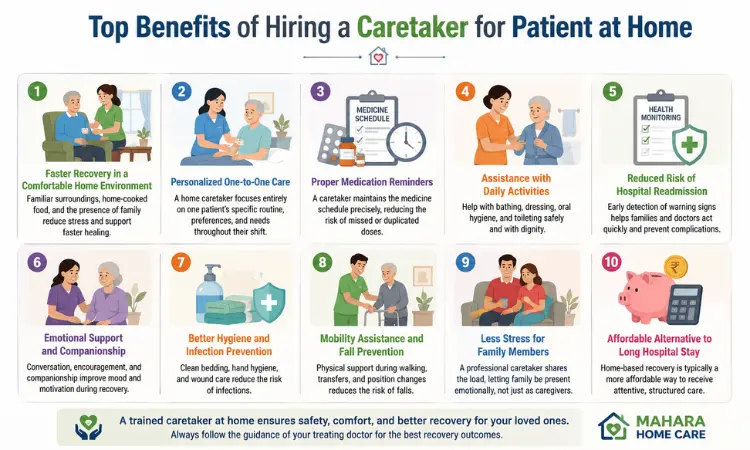
Top Benefits of Hiring a Caretaker for Patient at Home
1. Faster Recovery in a Comfortable Home Environment
Familiar surroundings, home-cooked food, and the presence of family reduce stress hormones that can slow healing. A caretaker maintains the structure a patient needs medication timing, rest periods, light activity within that comfortable environment.
2. Personalized One-to-One Care
Unlike a hospital ward where nursing staff manage multiple patients, a home caretaker focuses entirely on one patient’s specific routine, preferences, and needs throughout their shift.
3. Proper Medication Reminders
Missed or duplicated doses are a common and preventable cause of complications after discharge. A caretaker maintains the medicine schedule precisely, reducing this risk substantially compared to a busy family member managing it between other responsibilities.
4. Assistance with Daily Activities
Bathing, dressing, oral hygiene, and toileting can be physically difficult or unsafe for a weak or post-surgical patient to manage alone. A caretaker provides this support safely and with dignity.
5. Reduced Risk of Hospital Readmission
Consistent monitoring for early warning signs fever, wound changes, breathing difficulty, confusion allows families to contact the treating doctor promptly, rather than a complication going unnoticed until it becomes severe enough to require readmission.
6. Emotional Support and Companionship
Recovery can be isolating, particularly for elderly or homebound patients. Regular conversation, encouragement, and companionship from a caretaker measurably improve mood and motivation during a difficult period.
7. Better Hygiene and Infection Prevention
Consistent hygiene practices clean bedding, proper handwashing routines, wound area cleanliness meaningfully reduce infection risk during the vulnerable post-discharge window.
8. Mobility Assistance and Fall Prevention
Weakness after hospitalisation significantly increases fall risk, especially for elderly and post-surgical patients. A caretaker provides physical support during walking, transfers, and position changes, directly reducing this risk.
9. Less Stress for Family Members
Family members supporting a recovering patient alone often face their own exhaustion, disrupted work, and emotional strain. A professional caretaker shares this load, allowing family members to be present emotionally rather than solely as physical caregivers.
10. Affordable Alternative to Long Hospital Stay
Extended hospital stays carry high daily costs for room, monitoring, and staff. Home-based recovery with a caretaker is typically a more affordable way to receive attentive, structured support once a patient is medically stable enough to leave the hospital always in line with the treating doctor’s recommendation.
Patients Who Benefit Most from Home Caretaker Services
Professional caretaker services support a wide range of patients recovering or living with ongoing health needs at home. Patient Care Services in Mangalore and Patient Care Services at Home are especially valuable for the following groups:
| Patient Group | Why a Home Caretaker Helps |
| Elderly patients | Daily supervision, fall prevention, and companionship reduce isolation and risk |
| Post-surgery patients | Wound care support, mobility assistance, and monitoring during the critical first weeks |
| Stroke recovery patients | Mobility support, positioning, and consistent encouragement during rehabilitation |
| Cancer patients | Nutrition support, comfort care, and emotional companionship during treatment cycles |
| Orthopedic patients | Assisted mobility, positioning, and fall prevention during bone/joint healing |
| Paralysis patients | Full personal care support, position changing, and skin care to prevent pressure sores |
| Dementia patients | Patient, structured supervision and routine that reduces confusion and agitation |
| Alzheimer’s patients | Consistent caregiver familiarity, safety supervision, and gentle daily structure |
| Bedridden patients | Full hygiene care, feeding assistance, and regular position changes to prevent bedsores |
| Chronic illness patients | Ongoing health monitoring, medication reminders, and emotional support for long-term management |
Services Provided by a Caretaker for Patient at Home
A home patient caretaker typically covers seven categories of daily support:
Personal Care
- Bathing, grooming, dressing, and oral hygiene assistance, provided with patience and dignity.
Mobility Assistance
- Walking support, wheelchair assistance, bed-to-chair transfers, and regular position changing to prevent pressure sores. For patients needing structured rehabilitation, our physiotherapy at home services in Mangalore can be arranged alongside caretaker support.
Nutrition Support
- Meal preparation suited to the patient’s diet, feeding assistance where needed, and hydration support throughout the day.
Health Monitoring
- Temperature, blood pressure, and pulse monitoring, plus oxygen level monitoring where advised by the treating doctor with any concerning reading reported to the family and doctor promptly. This monitoring is basic observation, not a substitute for clinical assessment by a registered nurse or physician.
Medication Support
- Timely reminders and consistent maintenance of the medicine schedule set by the treating doctor.
Emotional Care
- Friendly conversation, companionship, mental encouragement, and motivation throughout the recovery period.
Household Assistance
Light housekeeping, laundry related to patient care, and maintaining a clean recovery environment — the practical, unglamorous work that keeps a home patient care taker arrangement running smoothly day to day.
How to Choose the Right Caretaker for Patient at Home
Choosing the right support matters as much as choosing to hire one at all. Evaluate any agency or individual caretaker against these factors before committing:
- Experience and background verification:
Confirm the caretaker has undergone government-issued ID verification and reference checks before placement never accept an unverified individual for patient care. - Medical knowledge:
Ask about the caretaker’s familiarity with the specific patient condition. Post-surgical care differs from dementia care, which differs again from bedridden patient care. - Communication skills:
A good caretaker reports changes clearly to the family and coordinates smoothly with visiting nurses or doctors. - Compassion and patience:
Technical competence matters, but so does the caretaker’s temperament especially for dementia, Alzheimer’s, or terminally ill patients who need gentle, unhurried care. - Shift availability:
Confirm whether 12-hour and 24-hour care options are available, and how shift handovers are managed. - Agency reputation:
Ask for references or reviews from other families, and confirm how the agency handles a caretaker being unavailable on a given day. - Emergency response readiness:
Ask what the caretaker and agency do if the patient’s condition changes suddenly the answer should include contacting the family, the treating doctor, and, if necessary, calling 112 or the nearest hospital without delay.
Choosing a trusted Caretaker in Mangalore means working with an agency that is transparent about verification, training, and emergency protocols not just availability.
Why Professional Home Care Is Better Than Managing Alone
Families considering whether to manage recovery entirely on their own should weigh the following realistically:
- Professional expertise:
Trained caretakers recognise patient care needs that untrained family members may not notice. - Better patient safety:
Structured mobility support and hygiene routines directly reduce fall and infection risk. - Consistent monitoring:
A dedicated caretaker observes the patient continuously, rather than in between other responsibilities. - Preserved family relationships:
Family members can focus on emotional connection rather than being stretched thin as the sole physical caregiver. - Reduced caregiver burnout:
Sharing the physical and logistical load protects the family’s own health and wellbeing during a demanding period. - Improved overall recovery experience:
Patients supported by trained caregivers alongside engaged family members generally report a calmer, more confident recovery experience.
Choosing Confidence Over Uncertainty in Recovery
Hiring a Caretaker for Patient at Home is one of the most practical decisions a family can make after a hospital discharge. It supports faster recovery, personalised attention, safer mobility, better hygiene, and meaningful emotional support while reducing the exhaustion that falls on family members trying to manage everything alone.
Every patient’s situation is different, and the right level of care should always be discussed with the treating doctor. With the right professional support in place, families can approach recovery with confidence rather than uncertainty, knowing their loved one is safe, comfortable, and cared for with dignity at home.
Frequently Asked Questions
1. What does a caretaker for patient at home do?
A caretaker for patient at home assists with personal hygiene, bathing, grooming, mobility support, meal assistance, medication reminders, and basic health observation such as temperature and pulse monitoring. They also provide emotional companionship. This is non-medical support that complements not replaces care from a doctor or registered nurse.
2. How soon after hospital discharge should a family arrange a home caretaker?
Ideally, arrange a caretaker before the discharge date so care begins the moment the patient reaches home. The first 1–2 weeks after discharge are often the most physically demanding, and having support in place from day one reduces stress and helps ensure the doctor’s discharge instructions are followed correctly.
3. What is the difference between a caretaker and a home nurse?
A caretaker provides non-medical daily living support — hygiene, mobility, meals, and companionship. A home nurse, registered with the Indian Nursing Council (INC), is trained to perform clinical tasks such as wound dressing, injections, and IV medication under a doctor’s protocol. Many recovering patients need a caretaker; patients with active medical procedures typically need a nurse as well.
4. Is 12-hour or 24-hour caretaker support better after hospital discharge?
This depends on the patient’s condition. Patients who are largely independent but need help with specific tasks often do well with 12-hour day support. Patients who are bedridden, at high fall risk, or recovering from major surgery typically benefit from 24-hour care. Discuss the patient’s specific needs with the treating doctor and the home care agency to decide the right shift structure.
5. How do I choose a trustworthy caretaker in Mangalore?
Verify that the agency conducts background checks and reference verification before placing a caretaker, ask about their experience with your specific patient condition, confirm availability for 12-hour or 24-hour shifts, and ask what happens if your assigned caretaker is unavailable on a given day. A trustworthy agency will answer these questions clearly and without hesitation.
| Need a trusted caretaker for your loved one at home? Mahara Home Care provides background-verified caretakers for patients recovering at home in Mangalore, Udupi, Manipal, and nearby areas with 12-hour, night-shift, and full 24-hour care options. Call or WhatsApp +91 72044 39333 for a free assessment call, or visit maharahomecare.com |
About the Author
Vijesh Kumar is a co-founder of Mahara Home Care with experience in home healthcare and patient support services. He focuses on providing reliable, compassionate care solutions for elderly people, patients, and families across Udupi, Manipal, Mangalore, Mysore and nearby areas.